
People ask us to choose between flake and polyaspartic all the time, and it is a fair question with a twist in it. One is what you see in the floor and the other is what holds it together, so the real choice is which pieces your garage needs.
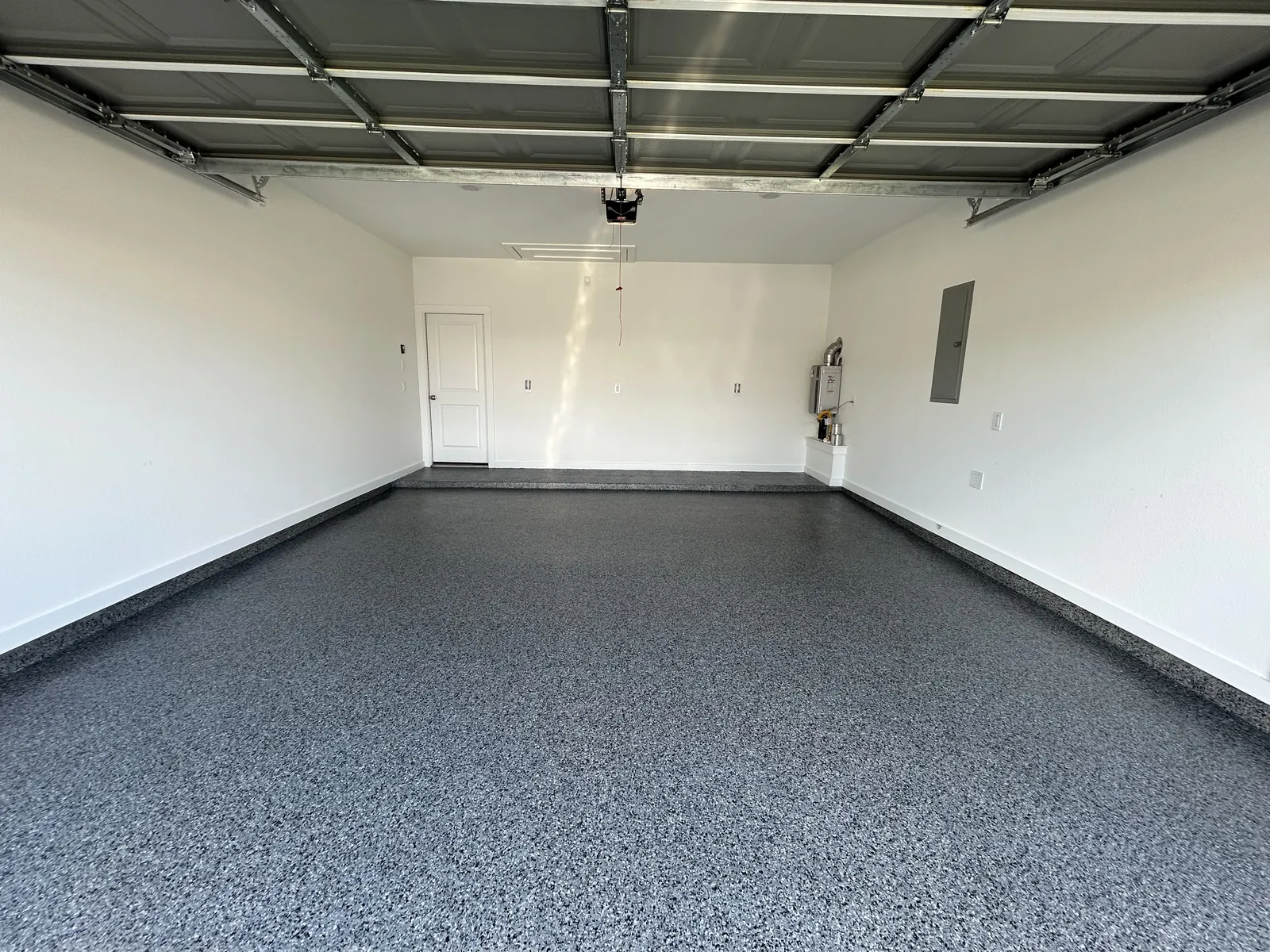
Two parts of one floor
Flake means the colored vinyl chips broadcast into a wet base coat until the surface is covered, then scraped, vacuumed and sealed under a clear topcoat. It is a look and a texture. It says nothing about which resin is holding the chips in place.
Polyaspartic is a resin, a cousin of polyurea, and it can be the base coat, the topcoat or both. It can go down clear, tinted or full of flake. So a flake floor might be built with an epoxy base and a polyaspartic top, or polyaspartic all the way through, or epoxy with a different topcoat. The question underneath is which resin belongs on each layer of your garage.
That is why the either-or question trips people up. Two floors that look identical from the doorway can have very different resins under them, and two floors with the same resin can look nothing alike. When someone tells us they want polyaspartic, we ask what they have heard about it, because the answer is usually speed or sun, and both of those point at specific layers.
What the chips do in a garage
Chips are mostly about hiding things. A garage collects dust, tracked-in dirt, leaf bits, tire marks and the occasional drip, and a solid-color floor shows every bit of it. A full broadcast of flake breaks the surface up so a week of grime reads as part of the pattern.
They also leave a slight texture once the topcoat goes over them, which gives shoes and tires a little more to hold when the floor is wet from a car coming in out of the rain. They add thickness too, which helps the floor take dropped tools and jack stands. Our garage floor flake systems page walks through the layers one by one.
Flake also forgives the slab. A garage floor with a few repaired cracks, old stains that would not grind out completely or patched spalls near the door looks even under a full broadcast, which a clear coat cannot manage.
What the resin choice changes
Epoxy builds thick and bonds hard to a ground slab, which is why it so often goes down first. It cures slowly, which gives the crew working time, and it ambers in sunlight unless something UV-stable goes over it. A garage floor epoxy base is a common start for that reason.
Polyaspartic usually cures much faster and holds its color in the sun, so it belongs as a topcoat on almost any garage where light comes through the door. Used for the whole floor, it can get a garage back in use sooner. The tradeoff is less working time, which matters on a big floor or a hot day, and it asks for a crew that has handled it plenty. Our polyaspartic garage floors page covers that side.
Neither resin rescues a bad slab. Both need a ground surface, repaired cracks and a moisture reading first, and the choice of resin comes after those. A slab that reads wet gets a moisture-mitigating primer under either one, and that call is made before anyone talks about chips.
A clear coat with no chips
Some people want the concrete to show. A clear or lightly tinted polyaspartic over a ground slab keeps the gray look, darkens it a little like wet stone, and protects it from oil, road salt and the drips that come off a car. It is a clean, simple floor.
It is also honest about the slab. Every patch, crack repair, old stain and trowel mark shows through clear resin, so it suits newer garages in good shape better than older slabs with a history. If the concrete has been patched a lot, flake usually makes the better-looking floor.
A slab can also be stained before a clear coat goes over it, which turns plain gray into something warmer without any chips. That is a different job with its own prep, and we would talk it through at the visit.
How the garage gets used
A garage that only holds two cars has different needs from one with a workbench, a fridge and a project car up on stands. Heavy use and dropped tools favor a thicker build with full flake. A garage that has to be back in service quickly points toward polyaspartic layers. A door that faces afternoon sun makes a UV-stable topcoat close to a must.
Washing matters too. If the floor gets hosed out, the texture from the flake and a topcoat with some grit in it help, since smooth clear resin gets slick with water on it. Garages that double as a shop also take spills of brake fluid and solvent, and a thicker build with a hard topcoat keeps those on the surface long enough to wipe up.
Temperature on install day matters for polyaspartic in particular. A hot garage shortens its working time even more, so on hot-weather jobs we plan the work around the cooler part of the day.
What we ask before we recommend
You can see a range of finished garages, flake and otherwise, in our gallery, which helps when you are still deciding how much of the concrete you want to see. Look at the floors closest to yours in age and use: a busy family garage, a weekend workshop, a tidy two-car space with a clear coat.
We settle the mix at the floor assessment, after the moisture reading and a look at the concrete. Along with the slab, we ask how you use the space, and the answers usually make the choice for us:
- Which way does the garage door face?
- How long can the garage sit empty?
- Do you work on cars or run tools in there?
- Does the floor get hosed out?
- How much does the slab show its age?
Questions
Can a flake floor be built with polyaspartic only?
Yes. Polyaspartic can carry the base coat, the broadcast and the topcoat, and that build can get a garage back in use sooner. Whether it is the right call depends on the slab, the temperature on install day and the size of the floor.
Is a flake garage floor slippery?
Less than a smooth clear coat, because the chips leave a slight texture under the topcoat. On a garage that gets wet often, we can add anti-slip grit to the topcoat for more grip. Any coated floor with standing water on it deserves some care.
Can flake go over a floor that is already coated?
Only if the old coating is sound and bonded everywhere, which is rare on a garage someone wants redone. Most of the time we take the old coating off and grind the slab, so the new floor is not sitting on somebody else’s problem.
Which one hides tire marks better?
A flake floor, especially a blend that mixes light and dark chips. Clear coats and solid colors show tire marks and stains more readily. Tire stain on a light floor often cleans up, and a busy blend keeps it out of sight between cleanings.
We look at the slab and read its moisture before anyone picks a finish. Call or text (936) 445-0702, email procoatepoxyflooring@gmail.com, or see the gallery first.