
One plain color, striped where the work goes
A solid color floor is pigmented resin rolled out in one even shade, with nothing broadcast into it to hide behind. Plants and warehouses choose it for exactly that reason: a dropped bolt or a fresh leak shows up the same day.
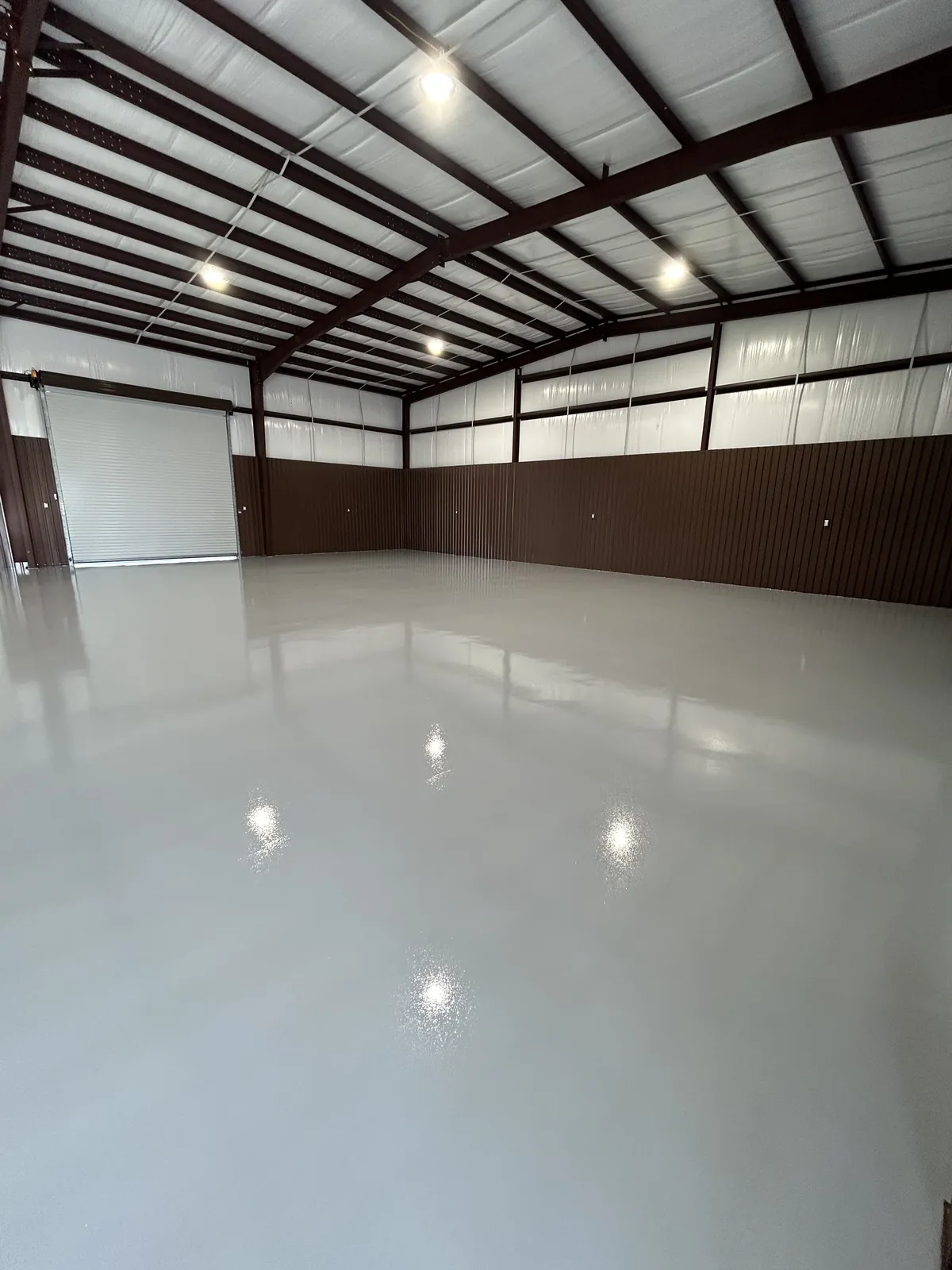
A floor that shows you what happened
In a plant or a shop, a floor that hides things is a problem. A solid gray or tan coat makes a dropped fastener easy to find and shows a hydraulic leak before someone slips in it. Lighter shades also bounce the overhead light back up, which helps in a dim building. The color is mixed into the resin itself, and we roll or squeegee it over a primed slab at the thickness the traffic calls for.
Light gray with yellow aisle lines is about as readable as a floor gets.
Laying out aisles on one color
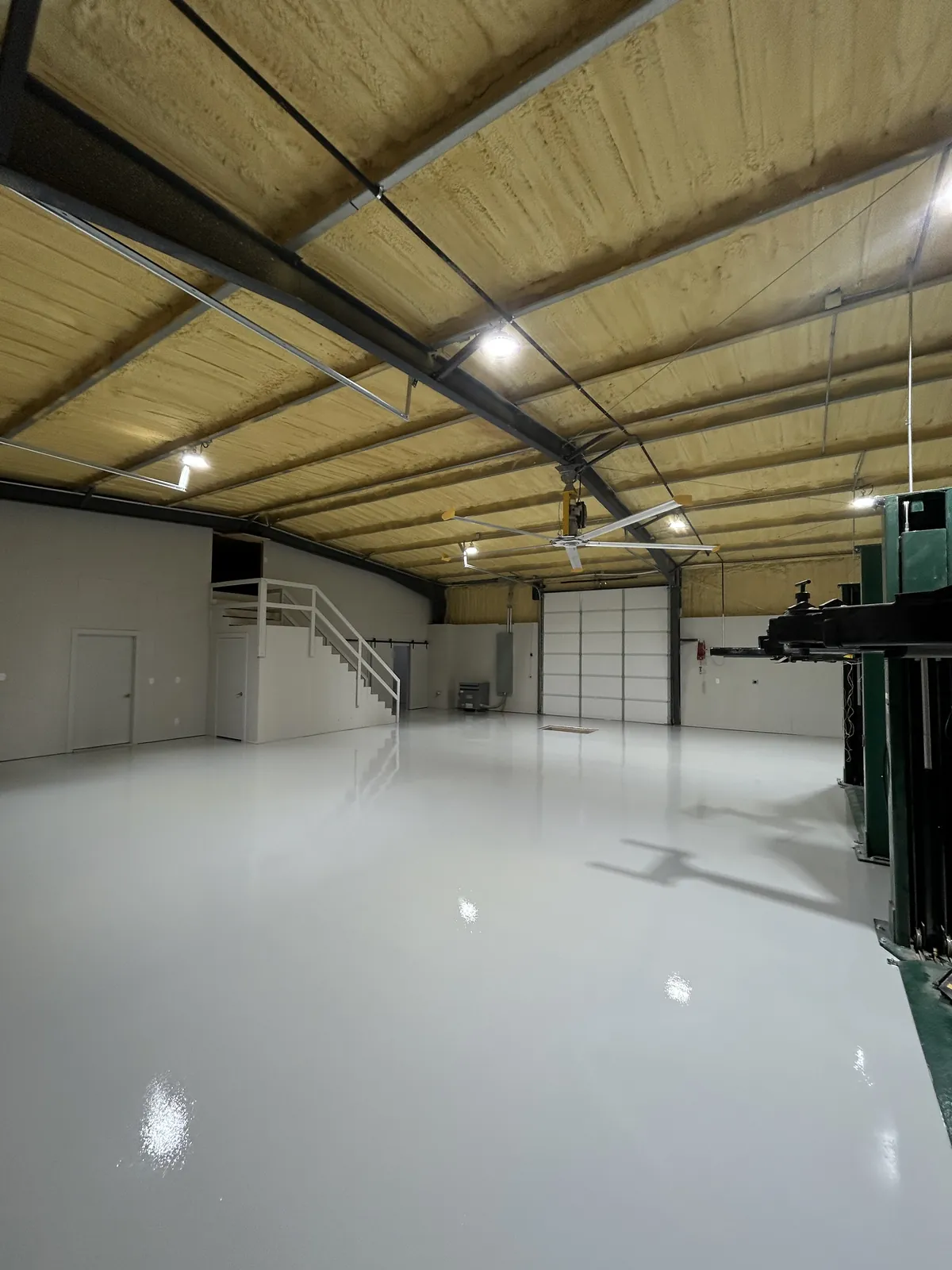
Striping is the main reason solid color shows up in commercial buildings. Forklift aisles, pedestrian walkways, keep-clear zones at electrical panels and parking bays for equipment all read clearly against one plain shade, and the same lines get lost on a busy speckled floor.
When plain epoxy is not enough
Plain epoxy has limits, and a lot of this system is about what goes on top of it or in place of it. Shops that spill brake fluid, solvents or battery acid get a chemical-resistant topcoat, because the base resin alone can stain. Bays with west-facing doors get a UV-stable top so the color does not yellow. Where a slab tested high for moisture, a moisture-mitigating primer goes under the whole system.
Commercial kitchens and food plants are the hardest case. Hot washdowns and grease break down ordinary epoxy, so those floors usually get polyurethane cement, a thicker trowel-down material that handles heat and can run up the wall as a cove base with no joint for water to sit in. It looks like a solid color floor and is built very differently, which is why it has its own group of pages here.
What to know first
- Looks like
- One even color with a satin or gloss sheen, and nothing in it for the eye to land on except the stripes.
- Holds up in
- Warehouses, manufacturing floors, auto shops, storage buildings and back rooms where aisles, bays and safety zones need clear lines.
- Wrong pick when
- We point people elsewhere when nobody will mop often, because one color shows tire marks and footprints the day they happen.
- Prep it needs
- Big open floors are often shot blasted, smaller ones diamond ground, and every crack and spall gets filled flush before color goes on.
- Compared with
- Warehouse owners weigh it against polished concrete, and garage owners against flake, which hides more of the daily dirt.
Solid color, by building
The coatings themselves come first, from basic epoxy to polyurethane topcoats. Then the buildings: warehouses and shops, kitchens and food plants, and floors that face chemicals or a damp slab.
Epoxy and coatings
- Epoxy Flooring
Epoxy starts as two liquids that we mix on site, and once they meet they harden by chemical reaction into a tough plastic film bonded to the concrete.
- Concrete Coatings
Coatings are the family we reach for when plain epoxy falls short: outside in the sun, on a floor that has to reopen fast, under spilled solvent or on a ramp that gets wet.
- Commercial Epoxy Flooring
For stores, offices, clinics and shops that can only close for a short stretch, so the system and the work schedule get planned as one decision.
- Industrial Epoxy Flooring
For plant and warehouse slabs that take loaded forklifts, pallet jacks and drips from machinery, built thicker and prepped harder than anything we put in a house.
- Industrial Floor Coatings
For production floors that get hit, scraped and hosed down every shift, where the coating thickness and the install schedule both come from how the plant runs.
- Protective Concrete Coatings
For bare slabs in shops, storage rooms and utility spaces that are wearing down or staining, where a sealer or thin coating adds a sacrificial surface.
- Polyurethane Floor Coatings
For the final clear coat on floors that get scraped by chair legs, carts and boots, protecting the epoxy beneath it and keeping a sheen longer.
- Epoxy Floor Sealing
A clear epoxy coat over bare concrete or a refresh over a worn clear layer on an existing epoxy floor, kept out of strong sun.
Commercial buildings
- Commercial Flooring
A business floor has two jobs: hold up to whatever the building does to it, and go down without shutting the business for longer than it has to.
- Warehouse Floor Coatings
Coating a warehouse around racking that stays put, with dock doors, dusty slabs and aisle lines handled in planned sections.
- Manufacturing Facility Flooring
Production floors done a line or cell at a time, around bolted machines, coolant mist, process fluids and hot work.
- Automotive Shop Flooring
Service bays built for lifts, jack stands, brake fluid, solvents, floor drains and tires that come in hot all day.
- Heavy-Duty Industrial Flooring
The heaviest builds for dropped steel, steel wheels, point loads and abrasion that would wear through a standard coating.
- Heavy-Duty Protective Flooring
Tough builds for barns, farm shops, loading areas and rental yards where buckets, jacks and gravel do the damage.
- Anti-Static Flooring
Static-dissipative or conductive floors for electronics work and server rooms, grounded to the building and confirmed at the assessment.
- Seamless Resin Flooring
One continuous resin floor with an integral cove and no grout lines, for clinics, labs, restrooms and kitchens.
Kitchens and food plants
- Restaurant Kitchen Flooring
Kitchen floors that take boiling water, grease and washdowns, sloped to drains with cove at the walls, usually urethane cement.
- Food Processing Facility Flooring
Plant floors built around the sanitation shift: hot water, steam, thermal shock beside coolers and trench drains.
- Hygienic Seamless Flooring
A continuous floor carried up the wall with sealed pipes and drains, so restrooms and clinics clean easily.
- Antimicrobial Flooring
Coatings with an antimicrobial additive, explained honestly: what it does on the surface and why cleaning still matters most.
- Polyurethane Cement Flooring
Thick urethane cement for floors that run hot or take hot water and steam, and where it is more floor than you need.
Chemicals and moisture
- Specialty Flooring Systems
Some floors have a single demand that decides everything else: a slab that reads wet, a room full of acid, a kitchen that runs hot, a clinic that has to clean in minutes.
- Chemical-Resistant Floor Coatings
For floors where solvents, brake fluid, acids or cleaners land regularly, matched to the actual substances on site instead of a general claim of chemical resistance.
- Chemical-Resistant Flooring
The whole floor of a chemical area, from containment and coved edges to trench drains and battery rooms.
- Moisture-Mitigating Floor Systems
The vapor-reducing layer that goes under the coating when a slab reads wet, and the point where even that is not enough.
The order the coats go down
Open the surface
We shot blast big open floors and diamond grind the rest, taking down ridges and old trowel marks on the way. The goal is concrete open enough for primer to soak in.
Fill it level
Cracks, spalls and joint edges get filled and ground flush. On one color, a patch that sits proud shows from across the building.
Prime for the reading
The primer is chosen from the moisture test. A dry slab takes a standard primer, and a damp one gets a moisture-mitigating primer before anything else.
Build the color
The pigmented coat goes down at the thickness the traffic needs, worked wet edge to wet edge so no lap lines dry in. Heavy floors get a second color coat.
Mark and topcoat
Aisles and safety zones are snapped out and striped on the cured color. The topcoat goes last: clear, chemical-resistant or gritted, depending on what the floor faces.
What the slab needs first
On commercial floors the prep usually means shot blasting, stripping whatever old coating is still hanging on, and testing the slab for moisture. Each has its own page under surface preparation, worth reading before a shutdown gets scheduled.
- Shot Blasting
Steel shot thrown at the slab to open big, open floors quickly where a grinder would take far longer.
- Concrete Moisture Testing
Readings that tell us whether vapor is coming up through the slab, which decides the primer and sometimes the whole system.
- Existing Coating Removal
Taking off a failed sealer, paint or coating and working out why it failed, so the new floor does not repeat it.
What comes up about solid color systems
Something else on your mind? Call or text (936) 445-0702, or use the contact page.
Which shade of gray works best in a warehouse?
A light to medium gray is the usual pick. It bounces more light than a dark floor, shows dropped parts and hides forklift tire scuffs better than near-white. Darker grays hide more and make the building feel dimmer.
Can a solid color floor take forklift traffic?
It can when the system is built for it: a ground or blasted slab, a high-solids coat at a heavier build, and often a second color coat. Turning wheels at the end of aisles and dock plates take the worst of it, so those spots are the first to need a touch-up. For the heaviest traffic, the heavy-duty industrial pages cover thicker options.
Does solid color epoxy work in a restaurant kitchen?
Not as a rule. Hot water and grease from washdowns soften and lift ordinary epoxy over time. Kitchens and food plants usually get polyurethane cement, which handles the heat, and it comes in solid colors too, so the look can be much the same.
What makes a floor anti-static?
Anti-static systems carry conductive material in the resin and a grounding connection, so a static charge bleeds off instead of jumping to a circuit board. They show up in electronics assembly and some labs. The requirement usually comes from the equipment maker or the facility’s own spec, so we start from that document.
Does a moisture problem rule out a coating?
Not always. A slab that pushes vapor can blister a standard system, and a moisture-mitigating primer is designed to hold it back so a coating can go on top. Very high readings, or water standing under the slab, can still point toward polished concrete instead. The test at the floor visit tells us which side of that line the slab sits on.
Show us the building and the traffic
Our crew will meet you at the building, take moisture readings and talk through color and striping with the layout in hand. Call or text (936) 445-0702 to book an on-site floor assessment.
- Call or text(936) 445-0702
- Emailprocoatepoxyflooring@gmail.com
- Based inConroe, Texas, working six counties
Want to see the work first? Browse the gallery, or find every way to reach us.