
Resin floors built for the room they cover
Epoxy starts as two liquids that we mix on site, and once they meet they harden by chemical reaction into a tough plastic film bonded to the concrete. Every floor on this page uses that same chemistry; what changes is how thick we build it, what we throw into it and what goes on top.
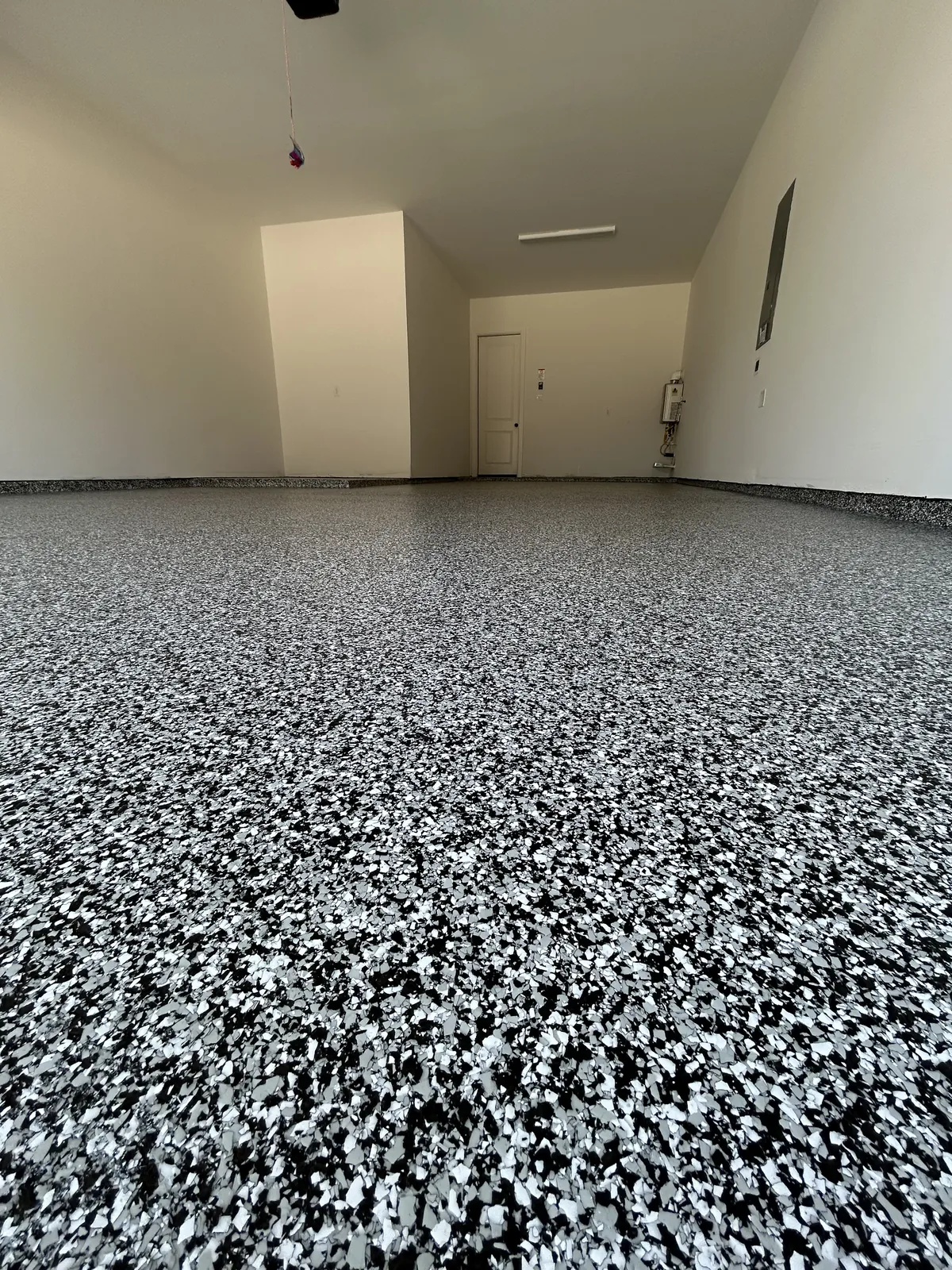
What every epoxy floor has in common
Epoxy holds on by soaking into concrete that has been ground open and then curing in place, so the bond is only as good as the surface under it. On a slab that was never ground, or one still carrying paint or sealer, the coating sits on top of a weak layer and comes away with it. That is why the grinder runs before any color is mixed.
It also builds thickness that a paint cannot. A garage epoxy might go down as a primer, a pigmented body coat full of flake and a clear top, and together those layers carry tire weight, dropped tools and the grit dragged in on boots. Thin roll-on kits from the store skip most of that, which is why they lift where the car parks.
Epoxy has two weak spots, and we plan around both. And it cures slowly, so a room coated with straight epoxy stays out of use longer than one finished with a faster product.
Sunlight turns most epoxy amber over time, so floors near an open door or under a skylight get a UV-stable topcoat.
Ten floors from one resin
The epoxy pages below split two ways. Four of them are about the room: a house, a business, a plant and a garage each wear a floor differently and need a different build. The other six are about the finish you see, from swirled metallic to plain gray with yellow aisle lines.
Those two sides meet on every job. A shop owner might want quartz for the wash bay and solid color under the lifts, and a homeowner might want metallic in the game room and flake in the garage. Either way the slab gets the same moisture reading and the same grind before we talk about color.
Every service in epoxy flooring
Each one has its own page with the detail, the prep it needs and the questions people ask.
Epoxy Flooring
- Residential Epoxy Flooring
For living spaces like dens, game rooms and kitchens, where comfort underfoot and easy mopping count for more than resistance to forklift traffic.
- Commercial Epoxy Flooring
For stores, offices, clinics and shops that can only close for a short stretch, so the system and the work schedule get planned as one decision.
- Industrial Epoxy Flooring
For plant and warehouse slabs that take loaded forklifts, pallet jacks and drips from machinery, built thicker and prepped harder than anything we put in a house.
- Garage Floor Epoxy Coatings
For the home garage, where a car parks on the slab every night, oil leaks down onto it, and summer heat tests how well the coating is bonded.
- Metallic Epoxy Flooring
For people who want the floor to be the centerpiece, with metallic pigment worked by hand into drifting patterns that look different from every angle.
- Decorative Flake Flooring
For busy floors that get swept less often than they should, since the scattered vinyl chips camouflage tracked-in dirt and add a slight texture underfoot.
- Quartz Epoxy Flooring
For restrooms, wash bays and food-service floors, where broadcast quartz sand gives a gritty, hard-wearing surface that stays grippy when the floor is wet.
- Solid Color Epoxy Flooring
For work floors where seeing a spill, a dropped part or a painted safety line matters more than hiding wear, so we roll one even color.
- High-Gloss Epoxy Flooring
For rooms built to impress, like showrooms and display garages, where a mirror shine is worth the extra sweeping and the scratches it will eventually show.
- Custom Epoxy Floor Designs
For floors that need to say something, such as a business mark at the entrance or school colors in a garage, laid out to scale with you before we start.
How we narrow it to one system
We start with the worst thing the room will do to the floor. For a garage that is a hot tire on a July afternoon. In a plant it is a loaded pallet jack dragged across the same aisle all shift. That decides how thick the build has to be and whether broadcast media belongs in it.
Next comes the moisture reading, and it can overrule everyone’s first choice. Epoxy laid over a slab that is still pushing vapor can blister even when the prep is perfect, so a high reading means a moisture-mitigating primer goes in first, and on some floors it means steering toward polished concrete instead.
Only then do we talk about looks, and we bring the trade-offs with us. Gloss and solid color show dust and scuffs. Flake hides almost everything. Quartz is the grippiest but the hardest to mop. Metallic needs the flattest slab of all. The choice usually gets easy once you hear how each one behaves after a year of use.
Common questions about epoxy flooring
Not answered here? Ask us on the contact page or call or text (936) 445-0702.
How is epoxy different from garage floor paint?
Paint dries into a thin film that mostly rests on the surface. Epoxy is a two-part resin that cures into a much thicker layer and bonds into concrete we have ground open. Painted garage floors tend to lift under car tires and wear through where people walk, and paint is one of the coatings we often grind off before starting.
Can epoxy go over the tile or sealer already on my floor?
Usually not. Tile has to come up first, and most sealers and paints leave a surface epoxy cannot grip. We grind or shot blast back to clean concrete, then repair what that uncovers, because a new coat over an old one fails wherever the old one does.
Does an epoxy floor get slippery when it’s wet?
A smooth gloss floor can, especially with water or oil on it. Flake and quartz floors have texture built in, and any system can take a grit additive in the topcoat. We match the amount of grit to how wet the room gets, since a rougher finish also holds onto dirt.
Why do some epoxy floors turn yellow?
Most epoxy resins react with ultraviolet light and slowly shift toward amber, starting wherever the sun reaches. Indoors under shop lights it is rarely a problem. Near garage doors, windows and skylights we finish with a UV-stable topcoat such as polyaspartic or polyurethane so the color stays put.
How long does an epoxy floor last?
That depends more on prep and traffic than on the resin. A floor ground and tested before coating, in a home garage, can go many years with only a fresh topcoat now and then. A forklift aisle wears faster, and we’d talk about recoating those floors at the assessment.
Do I need to empty the room before you start?
Yes, the floor has to be completely clear, since we grind wall to wall and the coating needs open space while it cures. In a garage that means cars, shelving and anything stored on the slab. For a business we plan the work around inventory and equipment moves so you know what has to go and when.
Part of Solid Color Systems
Epoxy Flooring is one of the services under solid color systems. The overview compares them all.
- Commercial Epoxy Flooring
For stores, offices, clinics and shops that can only close for a short stretch, so the system and the work schedule get planned as one decision.
- Industrial Epoxy Flooring
For plant and warehouse slabs that take loaded forklifts, pallet jacks and drips from machinery, built thicker and prepped harder than anything we put in a house.
- Industrial Floor Coatings
For production floors that get hit, scraped and hosed down every shift, where the coating thickness and the install schedule both come from how the plant runs.
- Protective Concrete Coatings
For bare slabs in shops, storage rooms and utility spaces that are wearing down or staining, where a sealer or thin coating adds a sacrificial surface.
Let us see the floor first
Tell us which room you have in mind and how it gets used. We’ll come take a moisture reading, look over the concrete and tell you which epoxy system we would put down, or whether epoxy is the wrong call.
- Call or text(936) 445-0702
- Emailprocoatepoxyflooring@gmail.com
- Based inConroe, Texas, working six counties
Want to see the work first? Browse the gallery, or find every way to reach us.