
Floors drawn out on paper before any resin moves
A custom floor is any coating where the color does more than cover the slab: a logo at the door, a border around the room, team colors in a garage, a metallic piece poured in a pattern. We plan the layout with you at the floor assessment, measure it against the room, and only commit to what the slab and the system can actually carry.
Laying out a design on bare concrete
At the assessment we measure the room, mark where the doors, drains, columns and joints fall, and sketch where the design would sit. A logo that looks centered on a drawing can land on a control joint or under a parked car, so we place it against the room you actually have.
On the floor, the layout gets snapped out with chalk and taped before any colored coat goes down. Each color is its own coat, so a three-color design means three rounds of taping, coating, curing and pulling tape. That is where most of the extra time on a custom job goes, and it is the reason we keep designs to shapes that tape can hold cleanly.
Straight lines, circles, arcs and bold block letters translate well. Thin script, tiny text and photo-style shading do not, because a roller lays resin down in a film and that film has edges. When a logo is too detailed to coat, we talk about a simplified version that keeps its main shapes.
Every custom floor starts on paper.
Borders, zones and color blocks
Most custom work is simpler than a logo. A contrasting border around a garage floor frames the space and hides the edge where the coating meets the wall. A work zone in a shop, a walkway in a showroom, a checkered or striped area in a gym: these are color layouts, and they are easier to get crisp than a piece of artwork.
Flake and quartz floors can carry a layout too. We broadcast one blend in one zone and a different blend next to it, then seal the whole floor under one clear topcoat. The line between blends is softer than a taped paint line, which suits some rooms and not others, so we talk about that edge before you decide.
Metallic art and what we can promise
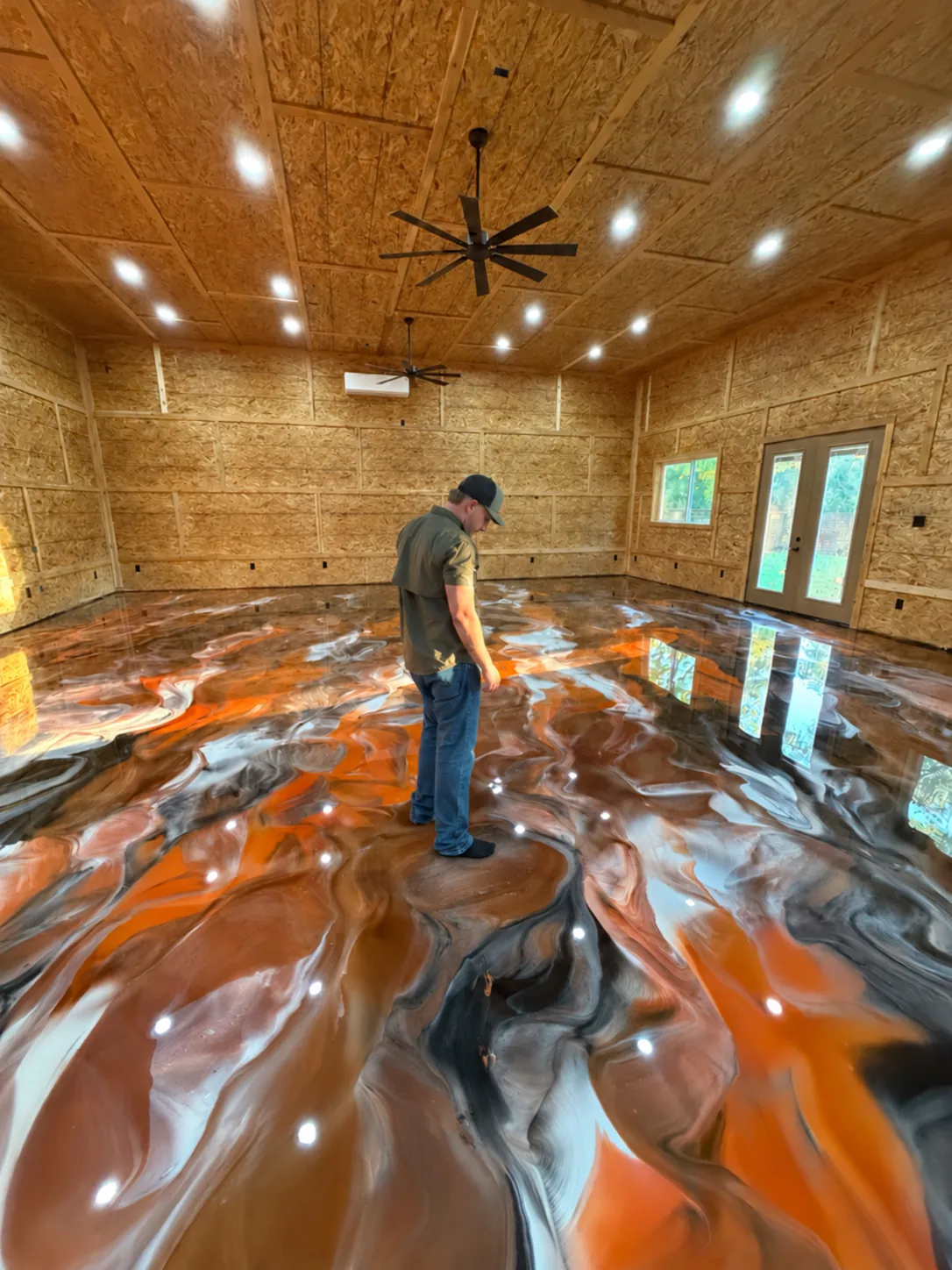
Metallic epoxy can be poured as a design: a river of one color running through another, or a field of swirls framed by a solid border. We can set where each color goes and roughly how it moves. The exact pattern comes from how the resin settles, so a metallic design is drawn as a plan and finished by the pour.
We handle every custom request the same way. The design gets settled at the assessment: the colors, where it sits, how big it is, and which parts are left to the resin. We do not promise an exact copy of a logo file or of a floor you saw somewhere else, and we would rather say that up front than after the floor cures.
Custom Epoxy Floor Designs at a glance
- Looks like
- Two or more colors laid out on purpose, from a simple border or striped zone to a logo, a color block layout or a metallic design under a clear coat.
- Holds up in
- Showrooms, lobbies, retail floors, gyms, shops and home garages where the floor carries a brand, marks out areas or is meant as a centerpiece.
- Wrong pick when
- It is the wrong pick when a layout depends on fine detail a roller and tape cannot hold, or when the room will soon be rearranged around it.
- Prep it needs
- The same grinding, moisture testing and crack repair as any coating, plus a level, clean surface where the lines will run, since tape will not seal over a pit.
- Compared with
- Most designs sit on a solid color, flake or metallic epoxy base, and simple ones are often compared with plain striping or a single accent border.
Where custom epoxy floor designs fits, and where it doesn’t
A good fit
- A showroom or lobby where the brand belongs at the front door.
- A garage floor with a contrasting border or a team color layout.
- A shop or gym that needs work zones and walkways marked out.
- A finished room where a metallic design is meant as the centerpiece.
Where we steer people elsewhere
- A logo full of fine script, where a sign on the wall shows the detail better than resin can.
- A rental space you may leave soon, where a plain solid color or polished concrete makes more sense.
- A floor with heavy moisture and no plan to mitigate it, where bare polished concrete avoids the problem entirely.
From sketch to sealed design
Measure and sketch
We measure the room at the assessment and sketch the design against doors, drains and joints. You see the placement before we commit to it.
Prep the whole slab
The floor gets ground, moisture tested and repaired like any coating job. Lines need a flat, clean surface or the tape lets color bleed under it.
Lay the base color
Primer and the main body coat go down over the full floor. This is the color the rest of the design sits on.
Tape and coat
We snap the layout, tape it and coat one color at a time, letting each cure before the next round of tape. Metallic sections are poured and worked inside their taped lines.
Seal it under clear
A clear topcoat goes over the finished design so foot traffic wears the clear layer instead of the colors. Doorways can get a fine grit in that coat.
Part of Metallic Systems
Custom Epoxy Floor Designs is one of the services under metallic systems. The overview compares them all.
- Retail Store Flooring
Customer-facing store floors that handle carts and rain at the door, done overnight or over a weekend so the doors stay open.
- Office Building Flooring
Lobbies, corridors and break rooms done after hours, polished where it suits and coated where spills and rolling chairs land.
- High-Gloss Epoxy Flooring
For rooms built to impress, like showrooms and display garages, where a mirror shine is worth the extra sweeping and the scratches it will eventually show.
- Showroom Flooring
A floor that flatters what sits on it under bright lights, with a topcoat that stands up to tires, display bases and scratches.
Before the visit: custom epoxy floor designs
Ask us directly: call or text (936) 445-0702 or write through the contact page.
Can you copy a logo file exactly?
We can get close on bold shapes and solid colors, and the closer the logo is to simple shapes, the closer the floor gets. Fine lines, small text and gradients get simplified, because resin goes down in coats with hard edges. We show you the simplified version before anything is taped.
Does each extra color add time?
Yes. Every color is its own coat, and each coat has to cure before the tape for the next one goes down. A border in one accent color adds a little. A logo in four colors adds several rounds, and we will give you the timeline once the design is settled.
Will the design wear off where people walk?
The clear topcoat takes the traffic, and the colors sit under it. In a busy entry the topcoat wears first, and it can be scuffed and recoated before the wear reaches the design. A design placed right where every cart turns will need that recoat sooner.
Can you add a design to the floor we already have?
Sometimes. If the existing coating is well bonded, we can scuff it, lay a design over it and seal the whole floor again. If it is peeling or soft anywhere, the design would fail with it, so the old coating comes off first.
Can a garage floor have team colors or a checkered pattern?
Yes, and those are some of the cleaner designs to coat, because they are made of straight lines and big shapes. A checkered layout takes careful measuring so the squares land evenly at the walls and the door. We work that out on the sketch first.
Where should a logo go on a floor?
Where people see it and nothing sits on it. Just inside the main entry is the usual spot, facing the way people walk in. We avoid control joints, floor drains and the places where a car, a rack or a desk will park on top of it.
Bring the logo to the assessment
Have the logo file, your colors or a rough sketch on hand, and we will measure the room and work out what the floor can carry. Call or text (936) 445-0702 to book an on-site floor assessment.
- Call or text(936) 445-0702
- Emailprocoatepoxyflooring@gmail.com
- Based inConroe, Texas, working six counties
Want to see the work first? Browse the gallery, or find every way to reach us.