
Flake floors that hide the dirt between sweeps
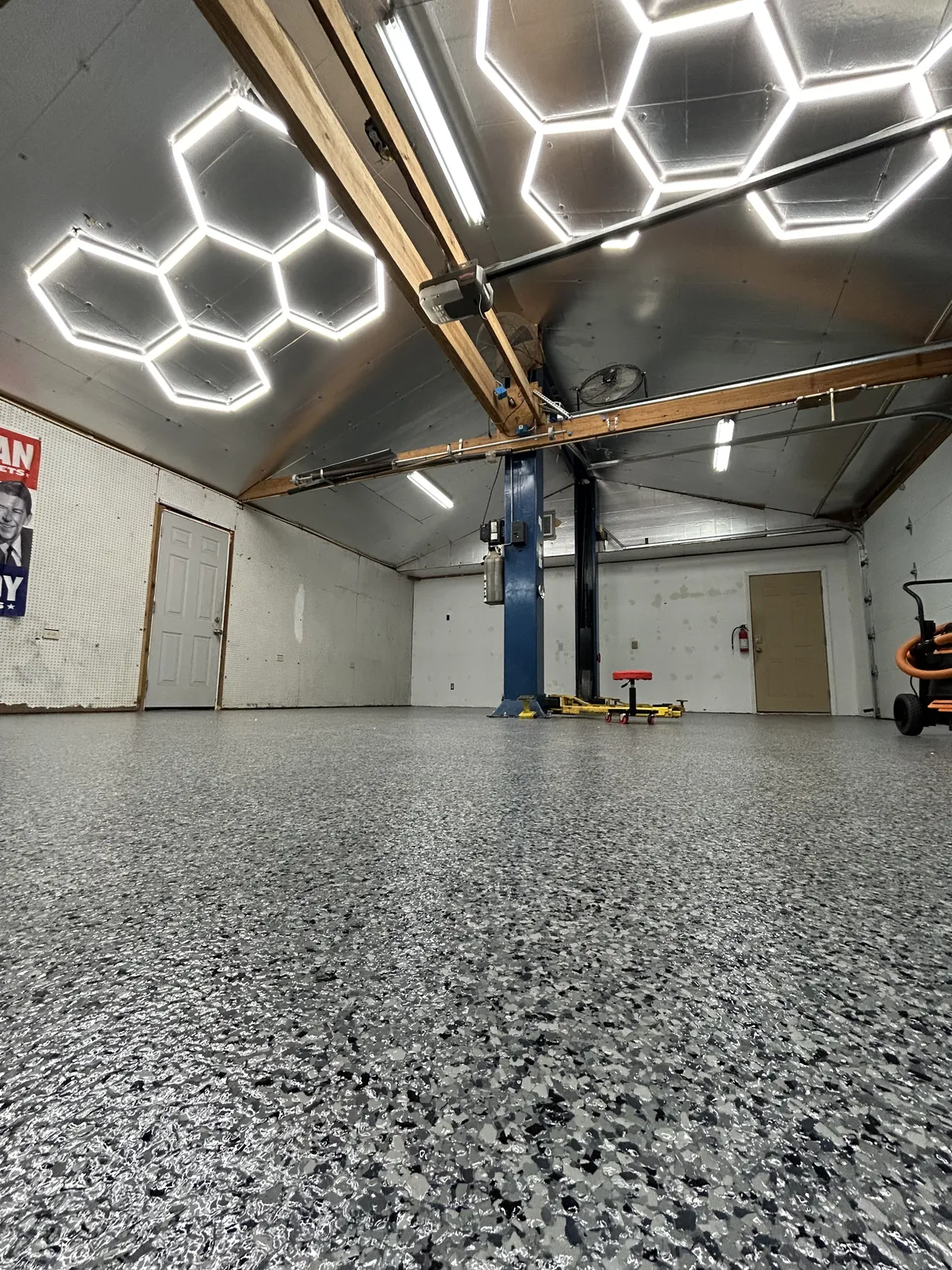
A flake floor is an epoxy base coat with colored vinyl flakes thrown into it while it is wet, then locked under a clear topcoat. From a few steps away the blend reads like granite, and the yard dirt that collects between sweeps disappears into it.
The floor for rooms that take dirt
Most of the flake floors we put down are in garages. A garage takes grit off the driveway, leaves off the yard, oil drips and whatever the dog rolled in, and a plain floor shows all of it the day it lands. Scatter flakes of three or four colors across the surface and the eye stops finding the dirt. The floor still needs sweeping. It just stops looking like it needs it every afternoon.
The same logic carries into the house. Mudrooms, laundry rooms, a home gym in the back of the garage, a workshop where sawdust settles on everything: these rooms get dirty on purpose, and a flake floor is built for that. Basements are rare around here because most homes sit on slab-on-grade concrete, so most indoor flake floors go on the same slab that runs under the rest of the house, right against the ground.
Outside, flake goes on covered porches, patios, pool decks and the occasional driveway apron. The sun changes the recipe. Plain epoxy turns amber under UV and the flakes look muddy through it, so outdoor floors get a UV-stable topcoat, usually a polyaspartic, and grit in the final coat wherever bare feet or rain land.
The clear topcoat is what you actually walk on, and it takes the scuffs and the dragged ladders.
Garages and the hot tire problem
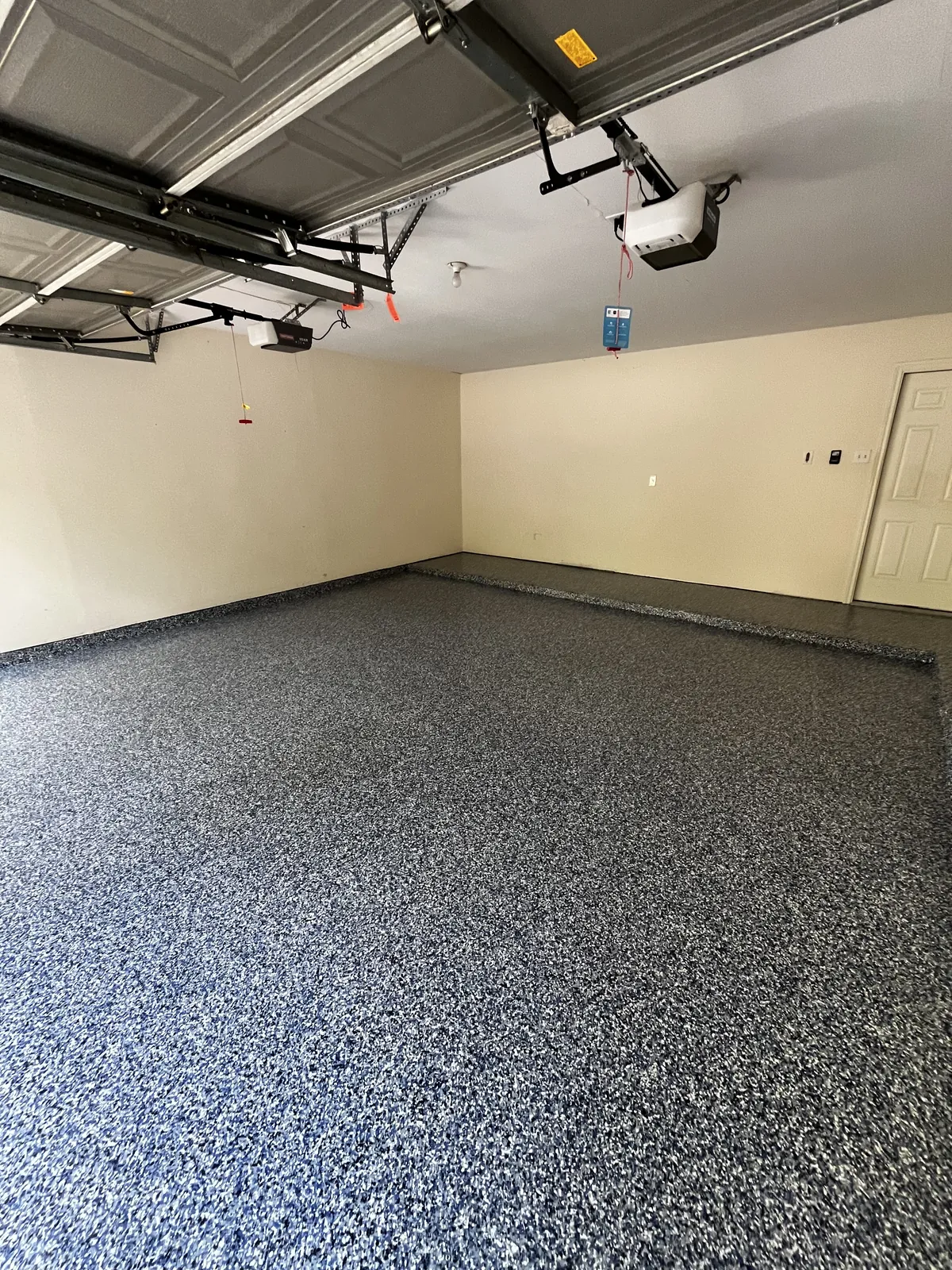
A car that parks after a long drive on a Texas summer afternoon brings tires hot enough to soften a weak coating. The softened film grabs the tire, and when the car backs out it pulls a patch of coating off with it. Store-bought kits fail this way often, because they go on thin over concrete that was washed instead of ground. Our garage floors start with a ground slab and a full body coat, and the flakes add thickness on top of that.
What the topcoat is there for
The flakes give the color. Before it goes down we scrape the cured broadcast to knock off loose flakes and sharp edges, then vacuum the floor clean. Skip the scrape and those edges stand up under the topcoat and snag mop strings for as long as the floor lasts.
Quick facts on flake epoxy systems
- Looks like
- From across the room it looks like granite or terrazzo, and up close you can feel a light texture underfoot.
- Holds up in
- Garages first, then mudrooms, home gyms, workshops, covered porches and pool decks, anywhere people carry dirt and water in on their feet.
- Wrong pick when
- We steer people elsewhere when forklifts run the floor all day or when the owner wants one smooth color with nothing scattered in it.
- Prep it needs
- The concrete gets ground open and old paint or sealer comes off, because the flakes are only as secure as the base coat’s bond to the slab.
- Compared with
- Most people compare it with quartz, which grips harder when wet, and with metallic, which looks richer and shows every scratch.
Flake floors, room by room
Garages come first: new floors, repairs to old ones and the prep in between. Then rooms inside the house, outdoor slabs in full sun, and the faster-curing coatings for when the cars need to come back sooner.
Garage floors
- Garage Floor Coatings
The garage is the floor we are asked about most, and the one that punishes a shortcut fastest.
- Garage Floor Flake Systems
The layered chip floor built for a garage, from base coat and broadcast to scraping and topcoats, with a blend that suits the house.
- Garage Floor Epoxy
The full garage system explained: how it differs from a kit, what the days on the job look like, and moving back in afterward.
- Garage Floor Epoxy Coatings
For the home garage, where a car parks on the slab every night, oil leaks down onto it, and summer heat tests how well the coating is bonded.
- Polyaspartic Garage Floors
Choosing a polyaspartic system for a garage that gets afternoon sun at the door or needs to be back in use sooner.
- Garage Floor Repair
Filling cracks, rebuilding chipped joints and fixing the broken edge at the door so a coating has a sound slab to follow.
- Garage Floor Resurfacing
A new cement surface over a garage slab that has scaled or pitted across the whole floor, left bare, sealed or coated after.
- Garage Floor Grinding
Grinding a garage slab back to open concrete, taking off kit epoxy or paint and smoothing a rough surface before anything else happens.
- Garage Floor Sealing
A sealer for people who want the garage to stay plain concrete but keep oil, tire marks and grime from soaking in.
Around the house
- Residential Floor Coatings
Floors around the house beyond the garage: rooms inside, the patio and porch, the pool deck, the driveway and the shop out back.
- Residential Epoxy Flooring
For living spaces like dens, game rooms and kitchens, where comfort underfoot and easy mopping count for more than resistance to forklift traffic.
- Basement Floor Coatings
Coatings for below-grade rooms and any room on damp ground, where vapor and musty smells come first and the finish second.
- Home Gym Flooring
A coated slab for a home gym, with rubber where weights drop and grip where sweat lands.
- Interior Concrete Flooring
Coated or polished concrete as the finished floor in kitchens, living rooms and converted garages, chosen room by room.
- Workshop Floor Coatings
Floors for a home shop or detached barn that take sparks, dropped tools, rolling boxes and a slab that may lack a vapor barrier.
Outdoors
- Patio Floor Coatings
A colored, gripping coating on a patio, built with a UV-stable topcoat for sun and water.
- Porch Coatings
Porch floors that stop peeling, with flake carried down the steps and a topcoat made for low sun under the eaves.
- Pool Deck Coatings
Pool deck surfaces chosen for bare feet, grip and pool chemicals, after the old broom finish or acrylic texture comes off.
- Driveway Coatings
A coating on a concrete driveway for color and protection, and the honest cases where a sealer is the better pick.
- Decorative Concrete Coatings
For concrete that works fine but looks rough, inside or out, where a colored or textured coating gives it a finished face chosen with the weather in mind.
- UV-Resistant Floor Coatings
For any floor that catches sunlight through a door, window or skylight, keeping colors true with a light-stable top layer over the epoxy.
Faster-curing coatings
- Polyaspartic Floor Coatings
For garages and sun-baked porches where the owner wants the floor back fast and the color to stay put, laid over a slab that has been ground and repaired.
- Polyurea Floor Coatings
For sorting out the polyurea family, which ranges from spray-applied industrial linings to the roll-on polyaspartics that turn up on garage floors.
Laying a flake floor, coat by coat
Grind and clean
We diamond grind the slab and take off old paint or sealer. Cracks get filled flush so no ridge shows through the flakes.
Tinted base coat
The epoxy base coat is tinted close to the main color of the blend. If a flake ever wears thin in a walking path, the color under it blends in.
Full broadcast
We throw flakes by hand into the wet coat until no resin shows through, one section at a time so no edge dries ahead of us. A partial broadcast stops early on purpose.
Knock down edges
After the coat sets we scrape off the loose flakes and the high edges. Then the floor gets vacuumed until it is clean enough to seal.
Lock it under clear
A clear topcoat locks the flakes down and sets how the floor feels underfoot. Porches, patios and pool decks get a UV-stable top with grit where water lands.
The slab work under every flake floor
A flake floor fails from the bottom up, at the bond between the base coat and the concrete, so the early work is grinding, stripping old coatings and testing for moisture. Those three steps each have their own page under surface preparation.
- Diamond Grinding
Diamond tooling that strips the smooth top and old residue so primer can soak into open concrete instead of sitting on top.
- Existing Coating Removal
Taking off a failed sealer, paint or coating and working out why it failed, so the new floor does not repeat it.
- Concrete Moisture Testing
Readings that tell us whether vapor is coming up through the slab, which decides the primer and sometimes the whole system.
Straight answers on flake epoxy systems
Something else on your mind? Call or text (936) 445-0702, or use the contact page.
Do flakes make a garage floor harder to clean?
A full broadcast leaves a light texture, a little like an orange peel. Wet mop with a mild cleaner and skip soap products that leave a film. Most people find it easier to keep looking clean than bare concrete, because the blend hides what the mop misses.
Should I pick big flakes or small ones?
Blends usually come in a few flake sizes. Larger flakes read bolder from the doorway and cover more of the base, while smaller ones look finer and closer to stone. Look at the blend in your own light before deciding, because a screen never shows the colors right.
Can a flake floor go on a pool deck?
It can, with a UV-stable topcoat and grit mixed into the final coat so wet feet have something to hold. Pool decks also take chlorine splash and full sun, so we look closely at drainage and at how the deck slopes before we commit to a coating.
Is polyaspartic a different floor from flake?
Not really. Polyaspartic is a resin, and it can be the base coat, the topcoat or both on a flake floor. It usually cures much faster than epoxy and stays clearer in sunlight, which is why it shows up on garages and porches. The flakes and the look stay the same either way.
Can a cracked garage slab still get flake?
Usually. Cracks get cleaned out and filled flush before the base coat, and the flakes hide the color of the patch. Clay soil here moves slabs, so a crack that is still opening may come back through any coating, and we will tell you what we see at the floor visit.
Start with a look at the floor
Tell us which room it is and what crosses it every day, and we will come test the slab and talk through flake blends in your own light. Call or text (936) 445-0702 to book a floor visit.
- Call or text(936) 445-0702
- Emailprocoatepoxyflooring@gmail.com
- Based inConroe, Texas, working six counties
Want to see the work first? Browse the gallery, or find every way to reach us.