
A colored, gripping coat for the back patio
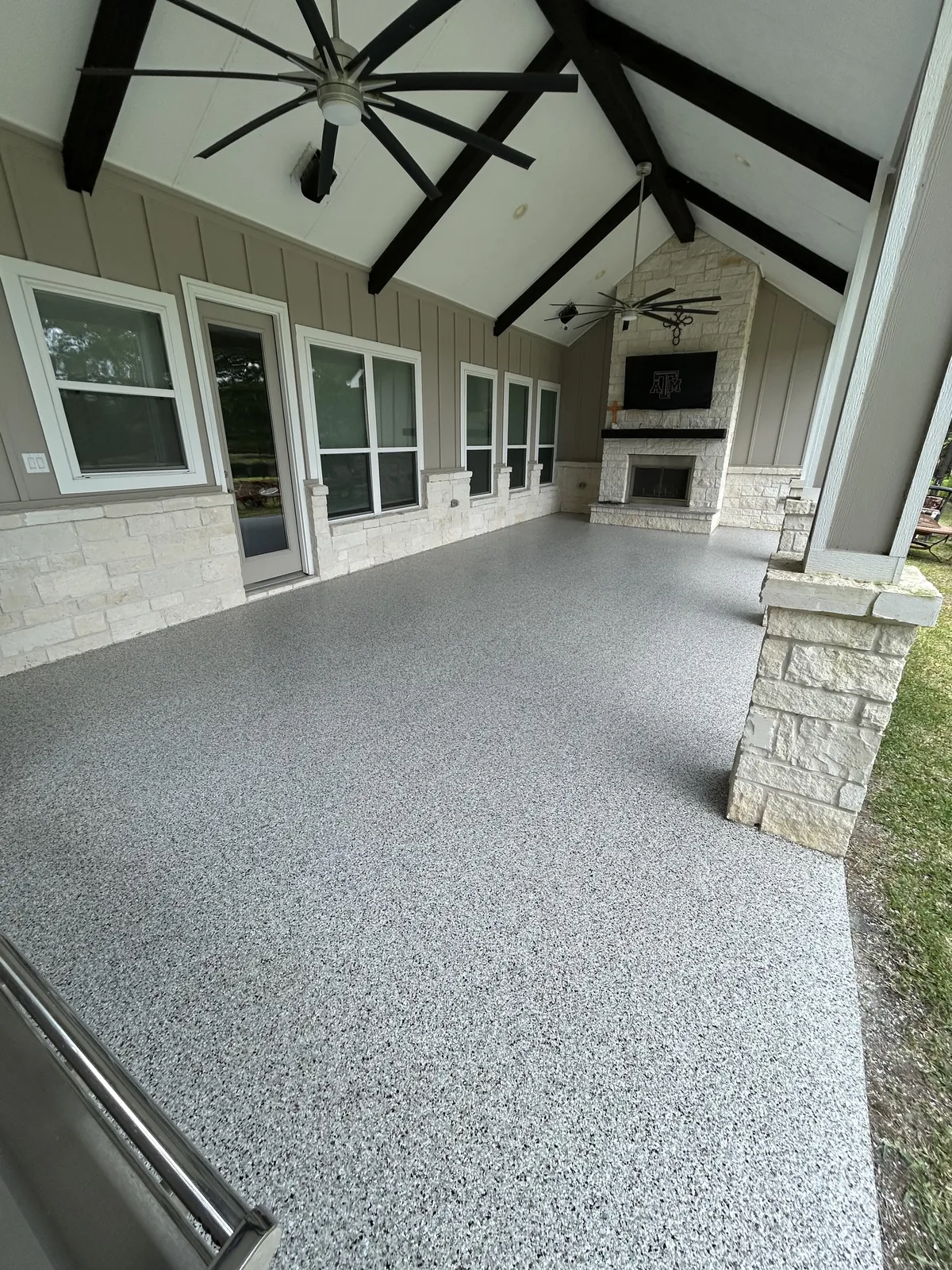
Sealing keeps a patio looking like concrete. A coating covers it with a new surface in a flake or quartz finish under a UV-stable topcoat with grit in it, and it has to take far more sun and water than any garage floor.
What the sun does to a coating
The clear layer that faces the sky has to be UV-stable, usually a polyaspartic or a similar outdoor product that holds its color. Under it, the body coat can be built for bond and thickness, because the topcoat shields it from the light.
Heat matters during the job too. A slab in afternoon sun gets hot, and a coating spread on hot concrete can set up before it is worked out properly. On a summer job we would rather start early in the day, before the sun reaches the slab, and keep checking the surface temperature as we go.
Color changes how the patio feels to bare feet. Lighter flake blends and quartz in tans and grays stay cooler than dark ones, and they hide the pollen and leaf dust that settle on a patio between cleanings.
Plain epoxy turns yellow and chalky in sunlight, so it never goes on top of a patio.
Water on top and water underneath
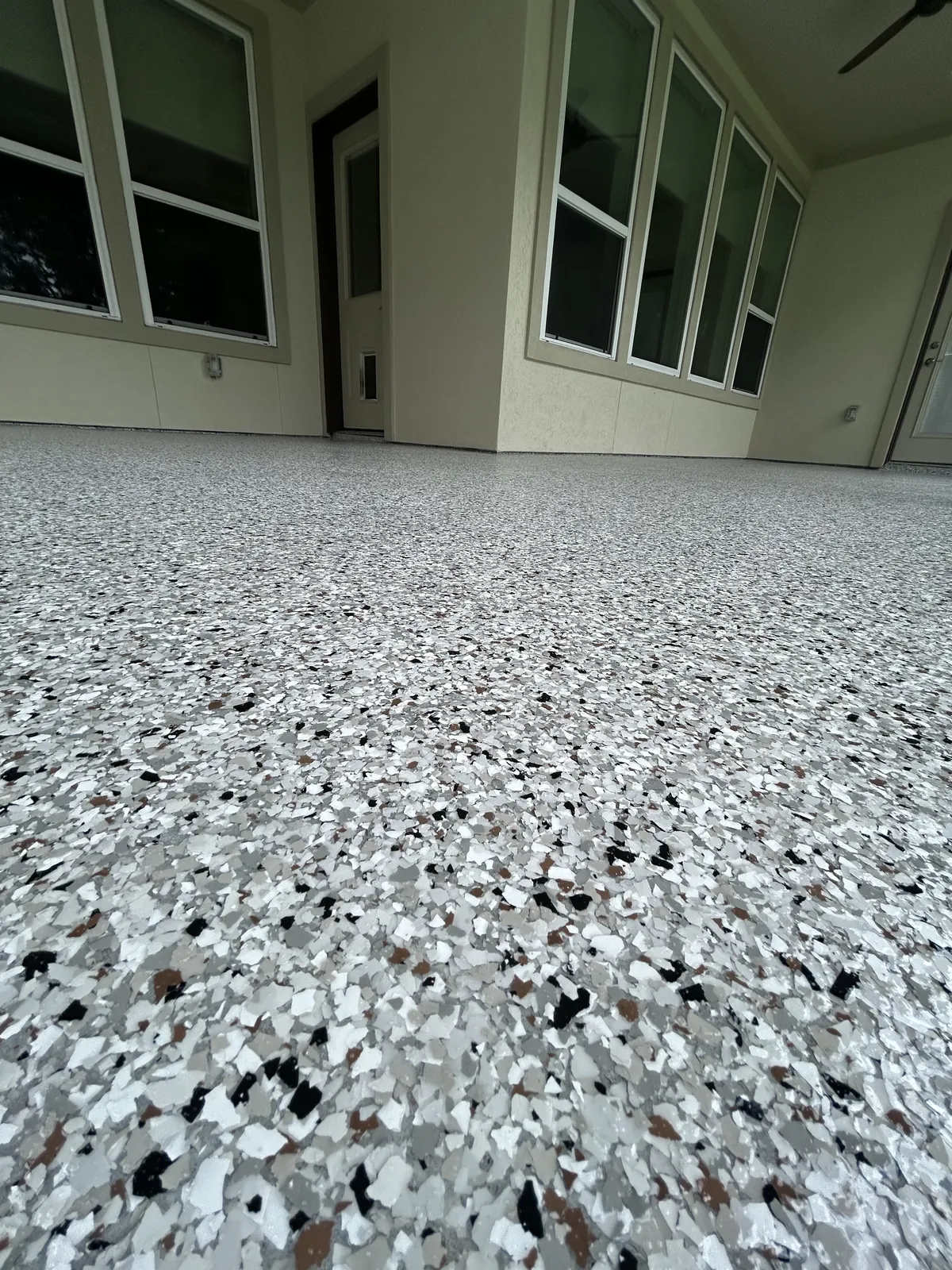
Rain, sprinklers and the hose make a smooth coat slick, so every patio coating gets grit mixed into the topcoat. Flake and quartz add some texture of their own. The grit can run heavier near the steps and the back door, where wet feet come in from the yard.
Water also comes from below. A patio slab sits right on the soil with no house over it, and after a week of storms it can be carrying a lot of moisture. We take readings on a patio the same as inside a house. If the slab stays wet, a coating that traps that water is the wrong product, and we would steer you toward a breathable sealer.
Chair legs, grills and slab joints
Metal chair legs and table feet drag across a patio every time someone sits down. On a coated surface they can scratch the topcoat, so glides or caps on the furniture make a real difference. Grill grease wipes off a coating far more easily than it lifts out of bare concrete, but a smoker or fire pit sitting right on the coating can scorch it, so those belong on a stand or a heat pad.
Most patios have control joints cut across them and an expansion joint against the house. Those joints move as the slab heats, cools and shifts on clay soil. Resin poured straight across them cracks along the line, so we keep the joints open and fill them with a flexible sealant that moves with the slab.
What to know first
- Looks like
- A speckled flake or fine quartz finish in colors picked to go with the house, under a satin top with a light texture underfoot.
- Holds up in
- Covered and open back patios, porches and grill areas on a sound slab that drains away from the house.
- Wrong pick when
- A patio that holds water, tips toward the foundation or stays wet and shaded most of the year is a better fit for drainage work or a penetrating sealer.
- Prep it needs
- Grinding off old sealer and paint, degreasing the grill spot, filling cracks, keeping the joints open and taking moisture readings.
- Compared with
- It gets compared with patio sealing, which keeps the bare concrete look, and with pavers, which mean tearing out the slab.
Patio Floor Coatings in the right place
A good fit
- A plain gray patio you want finished in a real color.
- A patio with old stains and patches that a sealer would only lock in.
- A covered back porch where wet feet come in from the yard.
- A grill area where grease should wipe off instead of soaking in.
Where we steer people elsewhere
- A patio that tips toward the house needs its drainage fixed before it gets any coating.
- If you like the look of the concrete itself, patio sealing keeps that look and protects it.
- A slab that stays wet in deep shade does better with a breathable penetrating sealer.
Building a coating that lives outside
Watch the water
We look at where water goes when it rains or the hose runs. A patio that drains toward the house gets that sorted out before any coating plan.
Grind and degrease
Old sealer, paint and grime come off with the grinder, and the grill spot gets degreased. Sealer left anywhere on the slab is a spot where the new coat won’t bond.
Repair and read
Cracks and chipped edges get filled, and the slab gets moisture readings. If the patio is soaked from recent rain, we wait for a dry stretch.
Throw the finish
Flake or quartz gets thrown across the wet base coat until it is fully covered. The extra comes off once it hardens, leaving the texture behind.
Top it for sun
A UV-stable clear coat goes on with grit mixed in, a little heavier at the steps. Then the joints get their flexible sealant.
Part of Flake Epoxy Systems
Patio Floor Coatings is one of the services under flake epoxy systems. The overview compares them all.
- Pool Deck Coatings
Pool deck surfaces chosen for bare feet, grip and pool chemicals, after the old broom finish or acrylic texture comes off.
- Driveway Coatings
A coating on a concrete driveway for color and protection, and the honest cases where a sealer is the better pick.
- Decorative Concrete Coatings
For concrete that works fine but looks rough, inside or out, where a colored or textured coating gives it a finished face chosen with the weather in mind.
- UV-Resistant Floor Coatings
For any floor that catches sunlight through a door, window or skylight, keeping colors true with a light-stable top layer over the epoxy.
Small print on patio floor coatings
Not answered here? Ask us on the contact page or call or text (936) 445-0702.
Should I coat my patio or seal it?
Seal it if you like how the concrete looks and want it protected. Coat it if you want a new color, a flake or quartz finish, or a way to hide stains and patches. A coating also needs a drier slab than a sealer does, which sometimes makes the choice for you.
Will the coating fade in full sun?
A UV-stable topcoat holds its color far better than plain epoxy, which yellows. Some slow change over many summers is normal for anything left outdoors. Lighter colors show it less than very bright or very dark ones.
How rough is the grit on bare feet?
We aim for enough grip to hold a wet foot without it feeling like sandpaper. Quartz has a little texture built in, while flake gets most of its grip from the grit in the topcoat. The area by the steps can carry a bit more.
Can you coat over old patio sealer?
No, the old sealer comes off first. Many patio sealers are made to keep things from sticking to the concrete, and that includes a new coating. Grinding takes it off and opens the surface so the primer can soak in.
How long before we can use the patio again?
That depends on the product and the weather. Polyaspartic topcoats usually cure much faster than epoxy, warm days speed things up, and a storm on the way can push the schedule back. We give you times for your patio once we know the system.
Can you coat the steps and the slab edge?
Yes. Steps get the same system with extra grit on the treads, and the exposed edge of the slab can be wrapped so the finish looks complete. Where the patio meets the lawn or a flower bed, we stop at a clean line and keep coating off the soil.
Have us look at the patio in daylight
Call or text (936) 445-0702 and tell us how much sun the patio gets and how you use it. We’ll come check the drainage, take moisture readings and tell you whether a coating or a sealer is the better fit.
- Call or text(936) 445-0702
- Emailprocoatepoxyflooring@gmail.com
- Based inConroe, Texas, working six counties
Want to see the work first? Browse the gallery, or find every way to reach us.