
Porch floors that stop peeling every few summers
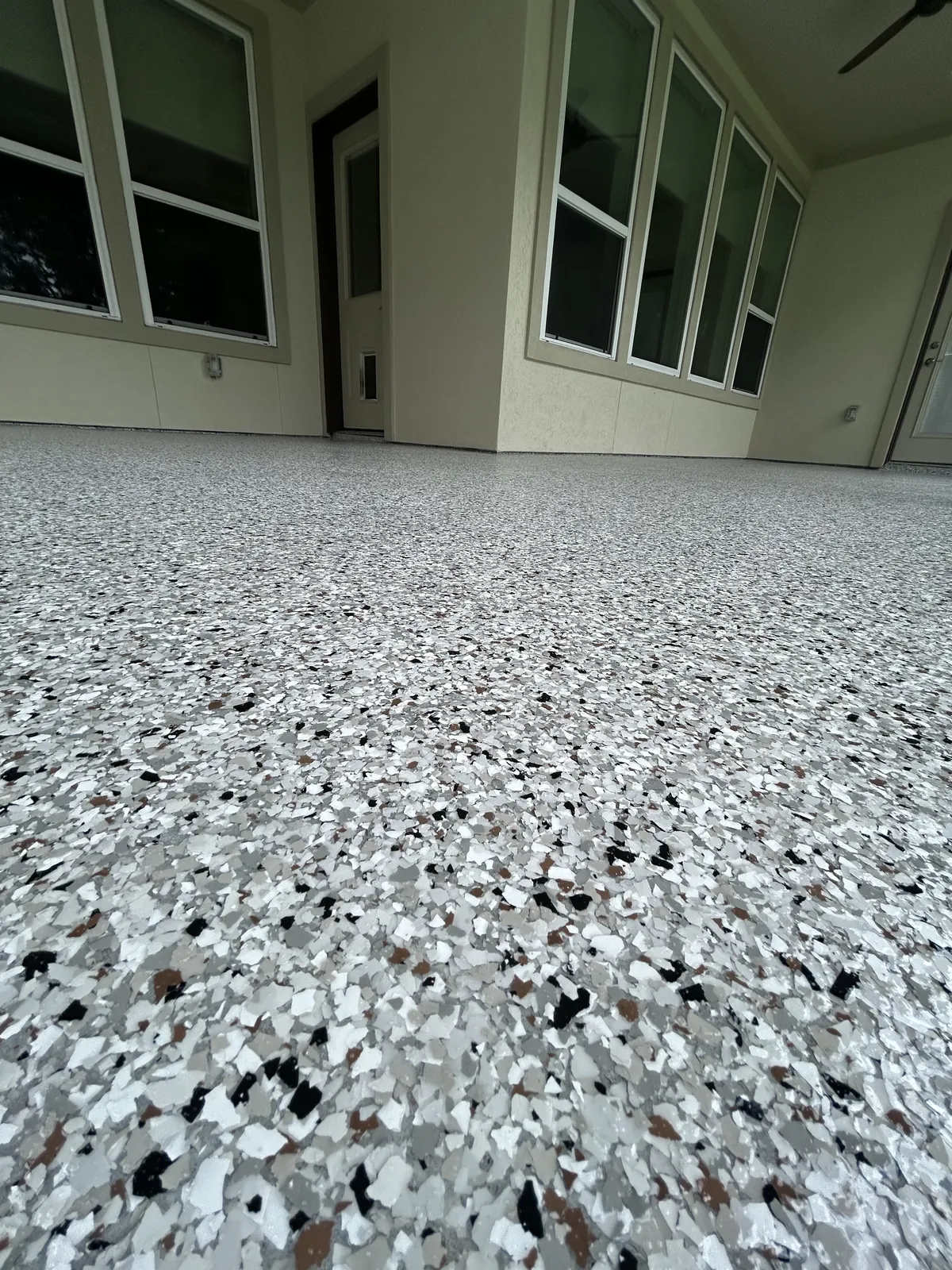
Most porches we look at were painted at some point, and the paint is coming up in sheets where people walk and where rain blows in under the roof. We take it all off, grind the concrete open and put down a flake floor with a topcoat made to handle the light that reaches a porch.
Why porch paint lets go
Porch paint is made to sit on top of the concrete, and a troweled porch slab is smooth and tight, so it has very little to hold onto. Add the moisture that moves up through any slab on grade and the rain a storm drives in sideways, and the paint starts to bubble and lift. It goes first at the top step and in front of the door, where the feet land.
The new coat sticks to the old one, the old one is still letting go of the concrete, and the whole stack peels together. So every porch starts the same way for us: the paint comes off completely, usually under a grinder, until we are looking at bare, open concrete again.
Bare concrete also shows what the paint was hiding: hairline cracks, an old patch that never bonded, a rail post base that has been bleeding rust into the slab. We fix those while they are out in the open, because once the flake goes down they are sealed in for good.
Repainting over it buys a year or two.
Light under the roof line
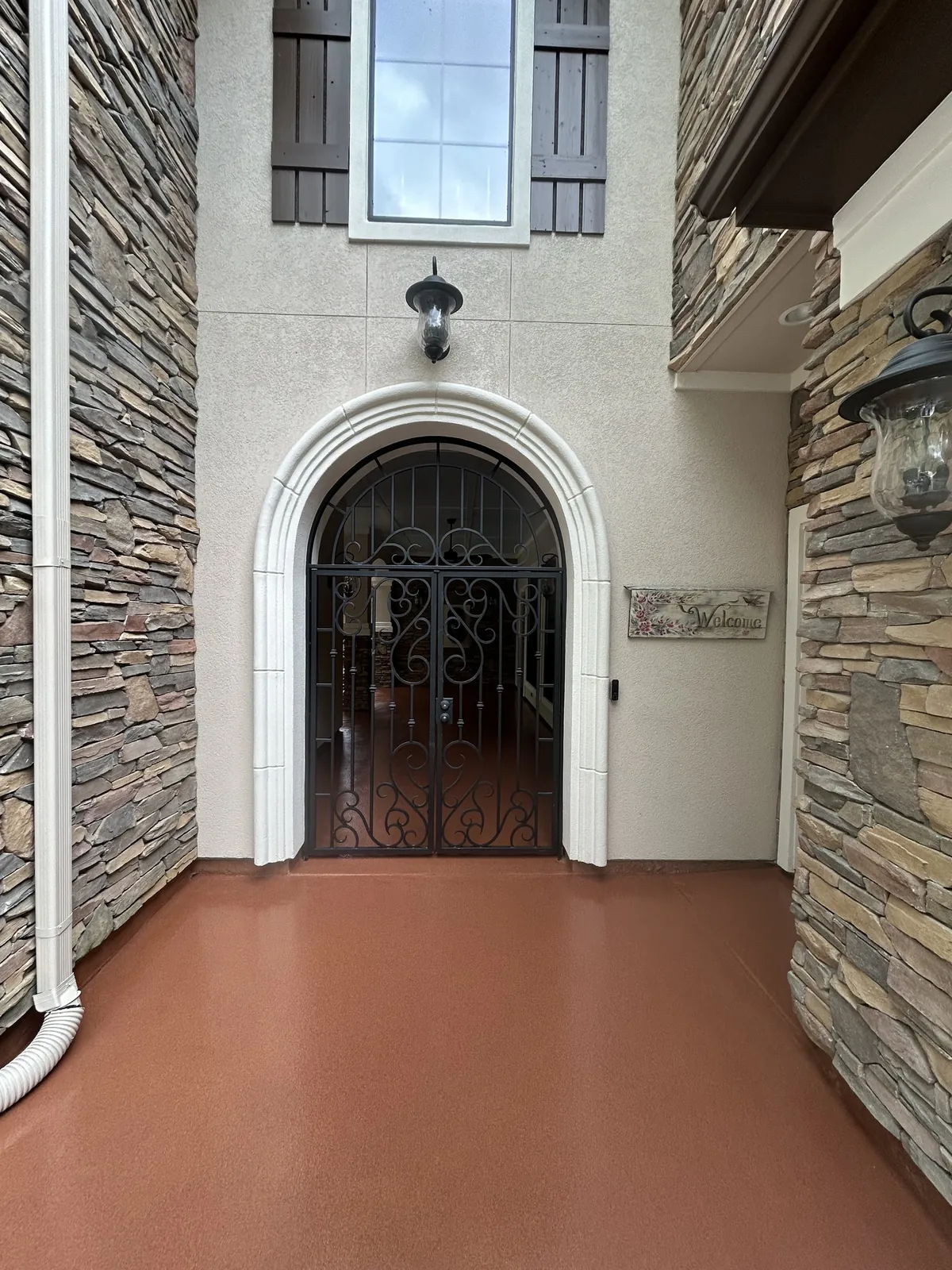
A roof keeps the rain off most of a porch, but it does not keep the sun off. Morning or evening light comes in low under the eaves and lands on the outer half of the slab, and that is enough to turn plain epoxy amber along a clear line. On porches the flake can sit in an epoxy or polyaspartic base, but the top layer is always a UV-stable product.
Heat matters too. A porch facing west can get hot enough in the afternoon that the coating has to go down early, before the slab warms up and the material starts setting faster than the crew can spread it. We plan the day around where the sun will be.
Steps, edges and the long porch
Steps are where porches get hurt. The front edge of each step takes heels, dropped planters and the hand truck bumping down with a delivery, and it is often chipped before we ever get there. We rebuild broken step noses with repair mortar, then carry the flake over the edge and down the face of each riser so there is no raw edge for water to get behind. The top of each tread gets fine grit in the topcoat.
Long porches along the front of a shop or barn bring their own issues. They are usually poured in several sections, and the far end can sit lower than the near one. We leave the joints between sections working, cleaned out and filled with a flexible sealant, instead of coating straight across them, and we watch how water runs off the full length before anything gets mixed.
The short version
- Looks like
- A broadcast flake floor in a blend picked to sit well against the siding and trim, finished in a clear satin or gloss topcoat.
- Holds up in
- Covered front porches, back porches off the kitchen and the long covered runs along the front of a shop or barn.
- Wrong pick when
- A porch slab that has dropped away from the house or broken into loose pieces needs repair first, and a slab with no roof and full sun may be better sealed.
- Prep it needs
- Every bit of old paint or sealer comes off, then the slab is ground, cracks and broken step edges are rebuilt and the moisture is tested.
- Compared with
- People compare it with plain porch paint and with a penetrating sealer, and it usually means a flake body coat under a UV-stable polyaspartic top.
The floors porch coatings belongs on
A good fit
- A covered porch with paint peeling at the door and the top step.
- A back porch off the kitchen that sees wet boots and the dog.
- A long covered porch along the front of a shop or barn.
- Porch steps with chipped edges that need rebuilding anyway.
Where we steer people elsewhere
- A porch with no roof over it, sitting in sun all day, usually does better with a penetrating concrete sealer than a film coating.
- Wood porches and paver porches are outside what we coat, so a deck builder or paver contractor is the better call.
- A slab that has pulled away from the house needs slab or foundation repair before any coating is worth putting down.
How a porch goes from paint to flake
Read the porch
We look at how the paint is failing, where rain reaches under the roof and where the sun lands on the slab. Steps, rail posts and the door threshold get a close look.
Strip the old paint
Paint and old sealer come off by grinding until the concrete is bare everywhere, step faces included. Edges along the siding get hand tools so the house stays clean.
Rebuild steps and cracks
Chipped step noses get rebuilt with repair mortar and cracks get filled. Joints between sections are cleaned out for a flexible filler.
Base coat and flake
Primer goes down, then the body coat with flake broadcast into it, carried over every step edge. Once it sets, the loose flake is scraped and vacuumed off.
UV-stable topcoat
A clear topcoat that holds its color in sunlight seals the flake in. The treads and the strip where rain blows in get fine grit mixed into it.
Part of Flake Epoxy Systems
Porch Coatings is one of the services under flake epoxy systems. The overview compares them all.
- UV-Resistant Floor Coatings
For any floor that catches sunlight through a door, window or skylight, keeping colors true with a light-stable top layer over the epoxy.
- Patio Floor Coatings
A colored, gripping coating on a patio, built with a UV-stable topcoat for sun and water.
- Pool Deck Coatings
Pool deck surfaces chosen for bare feet, grip and pool chemicals, after the old broom finish or acrylic texture comes off.
- Driveway Coatings
A coating on a concrete driveway for color and protection, and the honest cases where a sealer is the better pick.
Quick answers on porch coatings
Not answered here? Ask us on the contact page or call or text (936) 445-0702.
Do you have to strip the old porch paint?
Yes, all of it. Paint on a porch is almost always failing somewhere, and a coating bonded to it fails along with it. We grind it off, step faces included, so the new floor bonds to the concrete itself.
Will the coating get slick when rain blows onto the porch?
A smooth topcoat can be slick when wet, so we add fine grit to the treads and to the part of the porch that catches blowing rain. The covered middle near the door can stay smoother if you like. We settle that with you before the topcoat goes on.
Do the steps get the same flake as the porch?
Yes. We carry the flake over the nose and down each riser so the porch and steps read as one floor. Broken step edges are rebuilt first so the coating has solid concrete to wrap around.
How do you pick a flake blend for a porch?
A porch is part of the front of the house, so we look at the brick, the siding and the trim with you on site. Darker blends hide pollen and tracked-in red clay, and lighter blends stay a little cooler underfoot.
What happens around the porch posts and the front door?
We hand grind around posts and along the threshold, then coat up to them with a clean edge. Rusty post bases get dealt with first, since rust running off a post will mark the new floor. The door sill stays clear so the door still closes.
Can you coat a porch that runs the length of my shop?
Yes. Long porches usually have several sections and joints, and the slab can fall from one end to the other. We keep the joints working with a flexible filler and check the drainage along the whole run before we start.
Send us a photo of the peeling spots
Call or text (936) 445-0702 with a picture of the porch and the steps. We’ll come take a moisture reading, see how the paint is letting go and tell you what it takes to get the porch back to bare concrete and coated.
- Call or text(936) 445-0702
- Emailprocoatepoxyflooring@gmail.com
- Based inConroe, Texas, working six counties
Want to see the work first? Browse the gallery, or find every way to reach us.