
Plant floors built in layers, scheduled around downtime
An industrial floor is a system of layers, and the right one depends on how hard the floor gets hit, scraped, heated and washed. We choose between epoxy builds, broadcast systems and urethane cement after we see the plant, then plan the work around the days you can give up the floor.
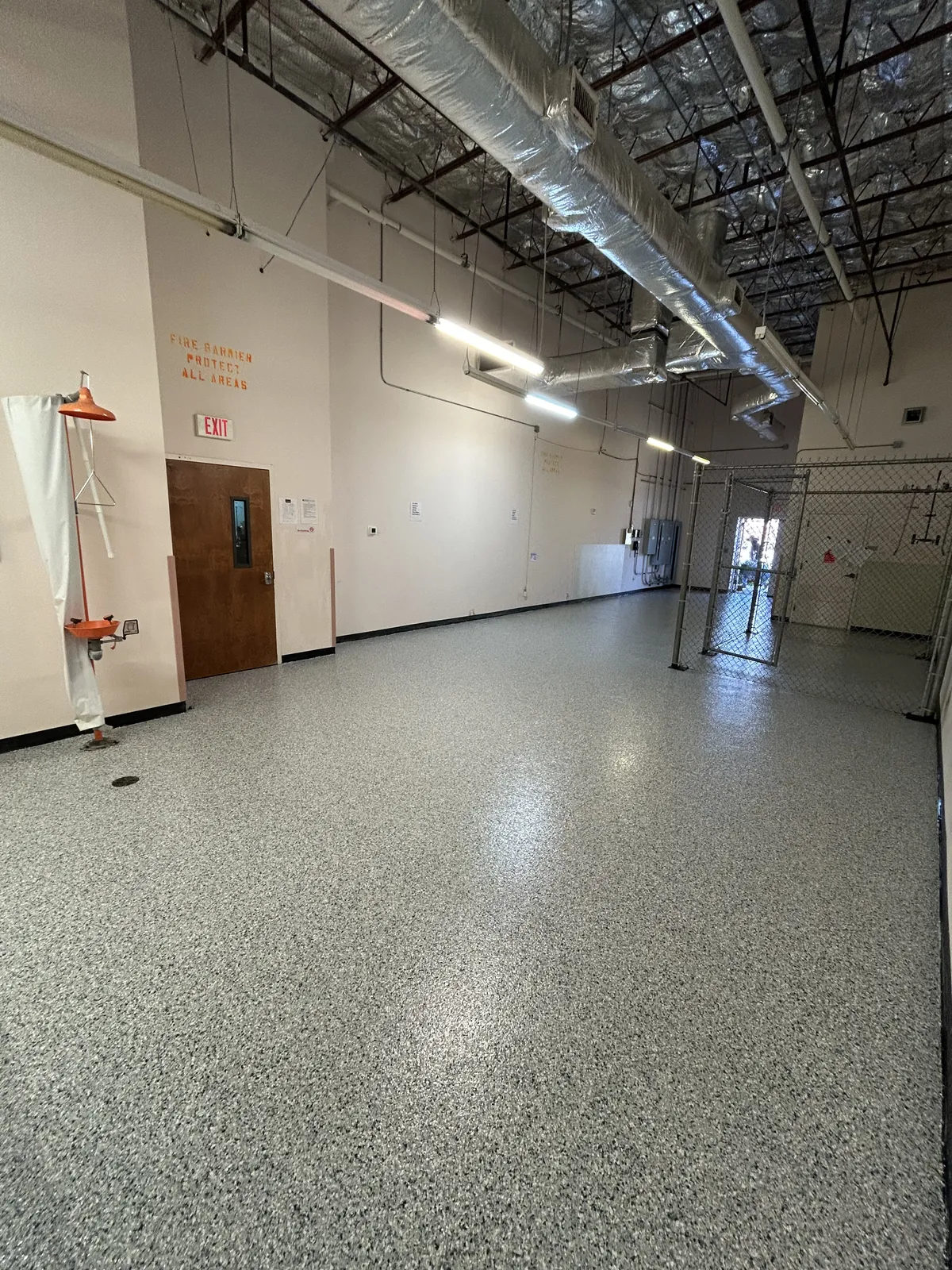
Thickness is what buys impact resistance
A dropped die, a steel part sliding off a bench or an overloaded pallet jack all hit the floor in one small spot. A thin coat rolled on at a few mils has nothing to spread that blow across, so it chips down to bare concrete. Industrial systems are built much thicker for that reason.
The common way to get there is a broadcast system. A body coat goes down, sand or quartz is broadcast into it until the resin disappears, and the excess is swept off once it sets. Repeat that and the floor gains real body, with a texture that stands up to scraping and gives boots some grip. A trowel-applied mortar goes thicker still for floors that take the worst of it.
Abrasion is the slower kind of damage. Grit tracked in on boots, pallets dragged on and off and casters rolling the same line every shift sand a floor down over the years. A tough topcoat over a filled, broadcast body takes that wear in a layer that can be recoated long before anything reaches the concrete.
Edges are where most industrial coatings start to let go when nothing anchors them.
When urethane cement belongs

Epoxy is the default on a lot of plant floors, and it has limits. Heat softens it, hot water and steam cleaning wear on it, and it doesn’t like a slab that runs damp. Urethane cement, a blend of urethane resin and cement, handles heat and sudden temperature swings far better and tolerates more moisture in the slab.
It’s the floor we look at for food plants, wash bays and anywhere hot liquids hit the floor on a regular basis. It goes down thick, usually with a matte, textured finish, and it’s built for survival more than looks. Where a room only sees dry traffic, a good epoxy system usually serves just as well.
Cove bases and where the coating stops
The joint between floor and wall is where water, dirt and cleaning chemicals collect. A cove base carries the coating a few inches up the wall in a smooth curve, so there’s no corner for grime to pack into and nothing for a squeegee to catch on. Wet-process rooms often need it for sanitation, and dry plants add it at wash stations and around equipment pads.
The coating also needs somewhere to stop. At doorways, drains and the edge of a coated area, we saw a keyway into the concrete so the coating locks in instead of ending on a thin feathered edge.
Quick facts on industrial floor coatings
- Looks like
- A thick, slightly textured floor in a plain working color, often with sand or quartz locked in and a cove that curves up the base of the walls.
- Holds up in
- Manufacturing plants, fabrication and machine shops, mechanical rooms, wash bays and process areas where the floor takes impact, abrasion and regular cleaning.
- Wrong pick when
- Light storage or office space with dry traffic rarely needs a thick industrial build, and a thinner coating or polished concrete ties up the floor for less time.
- Prep it needs
- Shot blasting on the open floor, grinding at the edges, keyways cut where the coating ends, and moisture testing in every bay.
- Compared with
- It’s often compared with polished concrete for dry areas, and inside the category the big choice is epoxy or urethane cement.
The floors industrial floor coatings belongs on
A good fit
- A machine shop where parts and tools land on the floor.
- A plant with wash stations, floor drains and regular hosing down.
- A process room that needs a cove base at the walls.
- A facility that can only give up its floor during a planned shutdown.
Where we steer people elsewhere
- Dry storage with light traffic is usually better served by polished concrete.
- A warehouse that mostly needs durable forklift aisles is a job for industrial epoxy flooring.
- Rooms that see strong acids or solvents need a chemical-resistant floor coating.
Planning the work around a shutdown
Map the plant
We walk every area that gets coated and note what happens in each one: impact zones, wash areas, hot spots and equipment that can’t move. Each zone can get its own system.
Set the schedule
We work out with you which areas can close and for how long, often a weekend or a planned shutdown. Bigger plants usually get done in phases, one zone at a time.
Blast and cut
Open floor gets shot blasted and the edges get ground. Keyways go in at every termination point, and drains and equipment pads get prepped by hand.
Repair the slab
Cracks, spalls and failed patches get rebuilt so the coating goes over solid concrete. A broadcast floor shows a dip just as plainly as a smooth one.
Build the system
Primer, body coats and broadcast layers go down to the thickness each zone needs, and the cove gets troweled in at the walls. Then the topcoat seals it.
Hand it back
Each zone opens to foot traffic first and to equipment later. We give you the times for every zone so production doesn’t roll back in early.
Part of Solid Color Systems
Industrial Floor Coatings is one of the services under solid color systems. The overview compares them all.
- Epoxy Floor Sealing
A clear epoxy coat over bare concrete or a refresh over a worn clear layer on an existing epoxy floor, kept out of strong sun.
- Epoxy Flooring
Epoxy starts as two liquids that we mix on site, and once they meet they harden by chemical reaction into a tough plastic film bonded to the concrete.
- Concrete Coatings
Coatings are the family we reach for when plain epoxy falls short: outside in the sun, on a floor that has to reopen fast, under spilled solvent or on a ramp that gets wet.
- Commercial Epoxy Flooring
For stores, offices, clinics and shops that can only close for a short stretch, so the system and the work schedule get planned as one decision.
Your industrial floor coatings questions
Not answered here? Ask us on the contact page or call or text (936) 445-0702.
How long will the plant floor be out of service?
It depends on the system, the size of the area and the temperature in the building. Urethane cement and epoxy cure at different rates, and a cold plant slows both. We set the schedule with you before the job starts.
What is a broadcast coating system?
A coating where sand or quartz gets scattered into the wet body coat until it’s fully covered. Once it sets, the loose material is swept off and the next coat goes on. It builds thickness and texture, which helps with impact and grip.
Do we need a cove base?
If the floor gets washed down or has to meet sanitation rules, usually yes. A cove keeps water and grime out of the corner where floor meets wall. In a dry machine shop it’s optional, though many plants still add it at wash stations.
Can you coat around machines that are bolted down?
Yes. We grind and coat up to the base of fixed equipment and seal the edge so water can’t work under it. Machines that can be moved come out of the way, since a coating under the footprint protects that concrete too.
Is urethane cement harder to clean than epoxy?
It usually has more texture, so it takes a little more scrubbing. In return it handles hot water and steam cleaning that would wear an epoxy floor down faster. For a wash bay or food plant, that trade is usually worth it.
Can a chipped spot be patched without redoing the floor?
Usually. A gouge from a dropped part can be ground out, filled with the same system and topcoated to blend in. Industrial floors are meant to be repaired in place, and the sooner a chip gets fixed, the less chance liquids work under its edge.
Tell us when the plant can close
Call or text (936) 445-0702 with what happens on the floor and when you can shut it down. We’ll walk the plant, test the slab and lay out a system and a schedule that fit both.
- Call or text(936) 445-0702
- Emailprocoatepoxyflooring@gmail.com
- Based inConroe, Texas, working six counties
Want to see the work first? Browse the gallery, or find every way to reach us.