
Floors for dropped dies and steel-wheeled carts
Some floors take punishment an ordinary coating won’t survive: a die slipping off the forks, or a loaded cart on steel wheels rolling the same lane all day. For those we build the heaviest systems we put down, and we look hard at the concrete before anything goes on it.
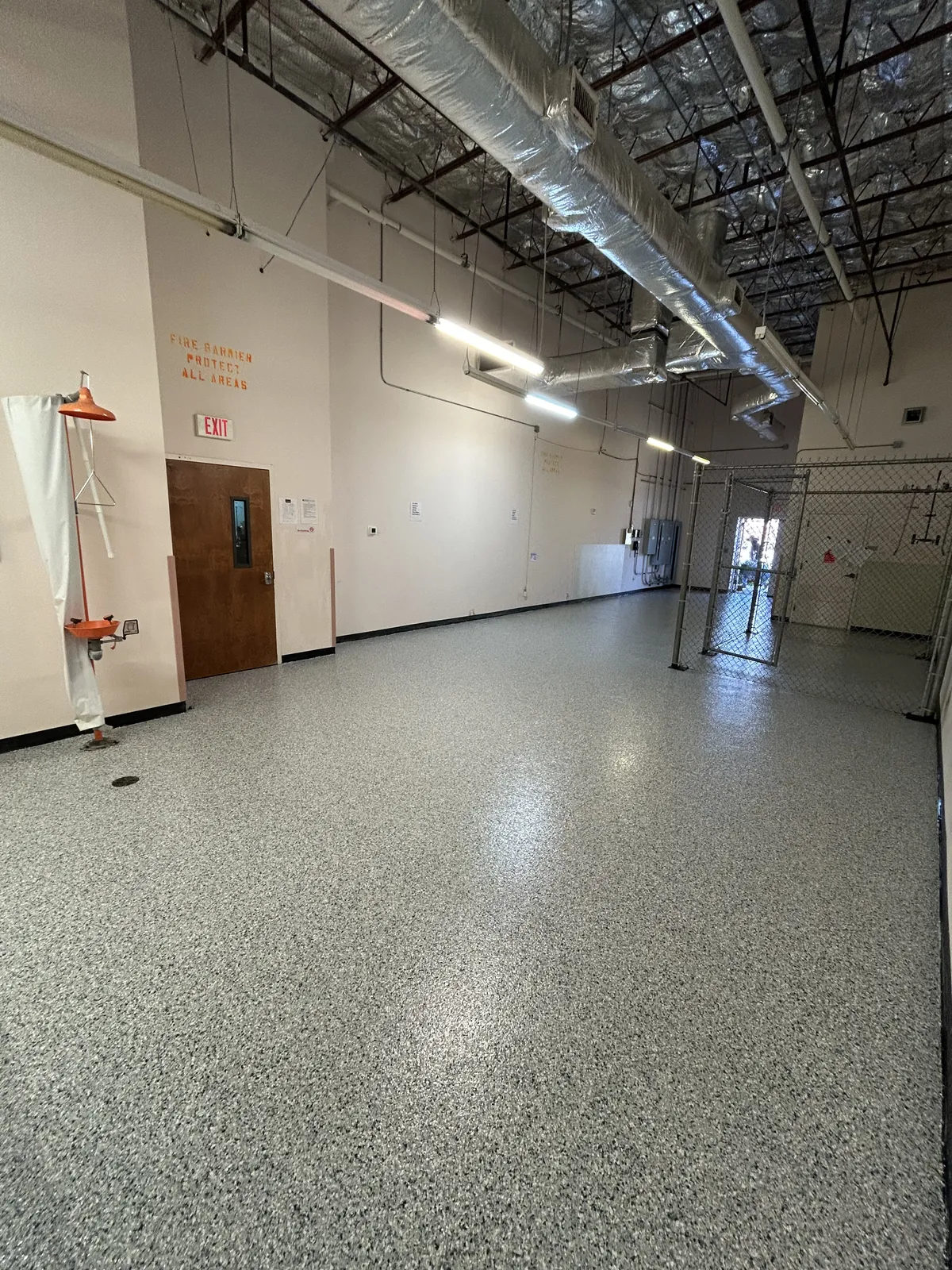
Steel wheels wear a lane in
Rubber and poly tires spread a load across a patch of tread. A steel wheel carries the same load on a thin line, and every pass presses grit into the floor under it. Die carts, steel-wheeled dollies and hand trucks rolling one route all day will grind a groove through a thin coating, then start on the concrete.
That’s the job troweled mortar was made for. It’s resin mixed heavy with graded sand or quartz and troweled out thick, so the wear surface is mostly aggregate held in resin. A broadcast system built up in several layers gets close to it on floors that take a little less. We choose between them by how heavy the wheels are and how often they roll.
Where a cart has to turn, the wheel scrubs sideways as well as rolling, and those corners wear fastest. We plan the thickest material for the turns and the stretch in front of a loading table, where carts stop and start.
Thin coatings shatter around that spot, and every chip lets oil and water in under the edge.
Dropped steel needs somewhere to go
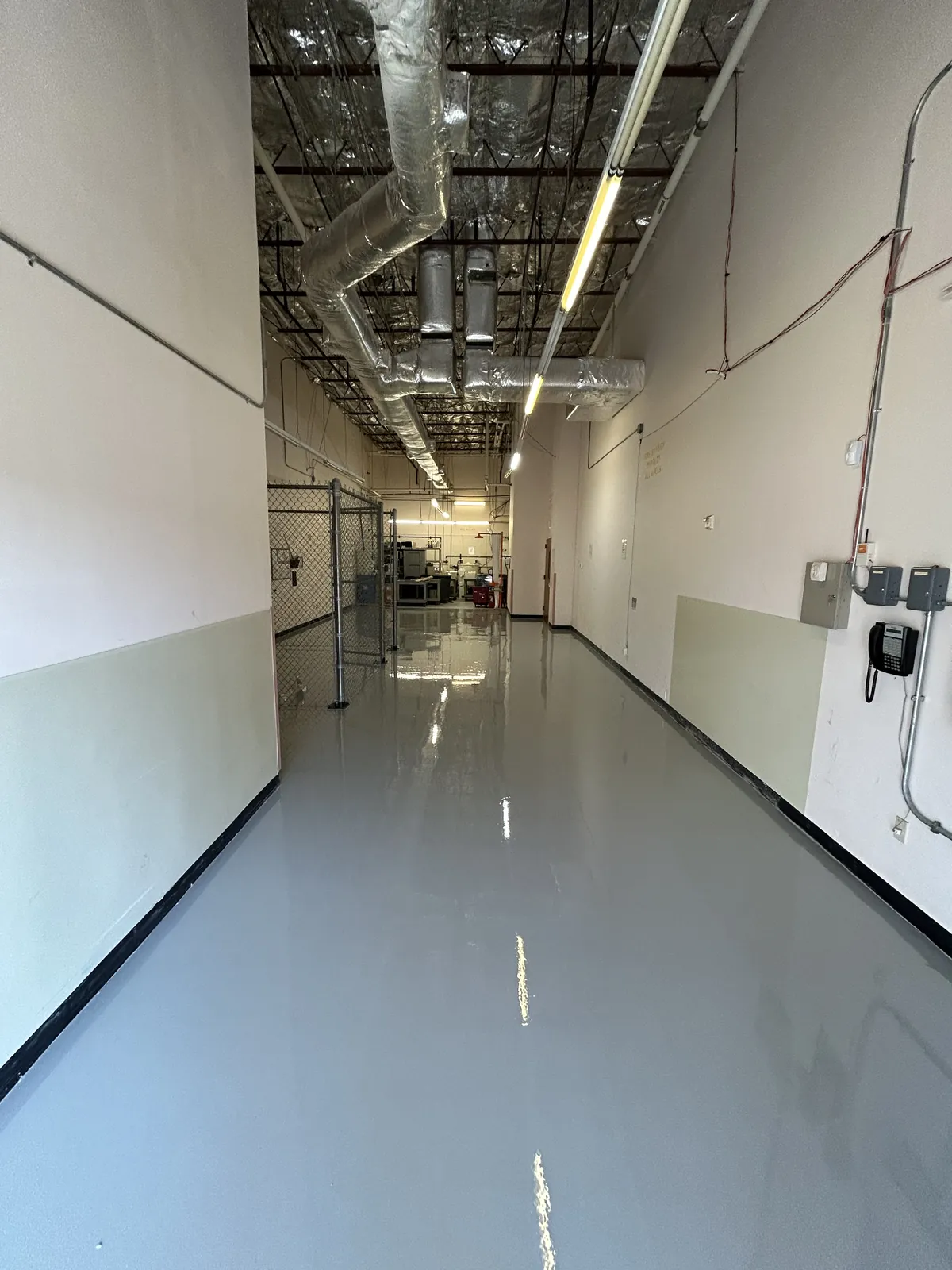
When a part comes off the forks, it lands on one corner with everything it weighs. A troweled mortar has body to take the blow, and when it does get dented, the damage stays in the mortar instead of running down into the slab.
No resin floor is steel, though. At the spots where heavy parts land every shift, such as under a press or beside a burn table, many shops lay down steel plate or a rubber pad over the coating and treat that square as a work surface. We would rather mark those spots at the walkthrough than patch them a month later.
A coating rides on the concrete
Point loads are the quiet problem. A rack foot, a machine leveling pad or a jack stand puts a lot of weight on a few square inches, and the coating passes nearly all of it straight down to the concrete. If the slab under it is weak, cracked or has a hollow topping that has let go, the heaviest system we build will crack right along with it.
So the assessment on these floors goes past moisture. We sound the slab for hollow spots, look at how the joints and cracks are moving, and check whether the surface is hard or dusts away under a scraper. Broken concrete gets cut out and rebuilt down to sound material first, because a heavy floor is only as strong as what it sits on.
The basics of heavy-duty industrial flooring
- Looks like
- A thick, flat working surface with a sandy or lightly textured finish in a plain color, closer to a hard shell over the slab than a coat of paint.
- Holds up in
- Fabrication shops, die and tool rooms, metal service centers, loading docks and maintenance bays where steel lands on the floor or rolls across it.
- Wrong pick when
- A floor with rubber-wheeled forklifts and no dropped loads rarely needs this much material, and industrial epoxy goes down faster.
- Prep it needs
- Shot blasting to a heavy profile, sounding the slab for hollow or weak spots, cutting keyways at every edge, and repairing broken concrete down to sound material.
- Compared with
- It gets compared with steel plate and with plain industrial coatings, and the two main builds are troweled mortar and multi-layer broadcast.
Choosing heavy-duty industrial flooring with your eyes open
A good fit
- A fabrication shop where plate and parts hit the floor.
- Steel-wheeled carts running one route all shift.
- A die room where heavy tooling gets moved by hand truck.
- A maintenance bay where jack stands and engine stands sit for days.
Where we steer people elsewhere
- Rubber-tired forklift aisles with no dropped loads are a job for industrial epoxy flooring.
- Rooms with hot washdowns and steam need our food processing facility flooring.
- Harsh acids and solvents need a chemical-resistant floor coating on top.
Building a floor for the worst hits
Find the impact zones
We walk the shop with your lead and mark where steel lands, where carts turn and what sits on point loads. Those zones get the heaviest build.
Sound the slab
We tap and drag the slab for hollow spots, take moisture readings and look at every crack. Concrete that sounds hollow gets marked for removal.
Blast deep, cut keyways
The floor gets shot blasted to a heavy profile so thick material can grab it. Keyways get sawn at doors, drains and every edge so the system ends locked in.
Rebuild bad concrete
Broken and hollow areas get cut out and patched with a repair material suited to the loads. Moving joints get a flexible sealant so they don’t crack the new floor.
Trowel or broadcast
Mortar gets troweled out in the heaviest zones, and broadcast layers go down where the abuse is lighter. A sealing coat fills the surface so it cleans up.
Load it in order
Foot traffic comes back first, carts next and point loads like racks and machines last. We give you a time for each so nothing heavy lands on a floor still curing.
Part of Solid Color Systems
Heavy-Duty Industrial Flooring is one of the services under solid color systems. The overview compares them all.
- Automotive Shop Flooring
Service bays built for lifts, jack stands, brake fluid, solvents, floor drains and tires that come in hot all day.
- Heavy-Duty Protective Flooring
Tough builds for barns, farm shops, loading areas and rental yards where buckets, jacks and gravel do the damage.
- Anti-Static Flooring
Static-dissipative or conductive floors for electronics work and server rooms, grounded to the building and confirmed at the assessment.
- Seamless Resin Flooring
One continuous resin floor with an integral cove and no grout lines, for clinics, labs, restrooms and kitchens.
Six questions about heavy-duty industrial flooring
Ask us directly: call or text (936) 445-0702 or write through the contact page.
What is a troweled mortar floor?
It’s resin mixed with a heavy load of sand or quartz and spread thick with a trowel, much like laying a thin concrete topping. Once it cures, a sealing coat fills the surface. It’s the build we reach for where steel wheels and dropped parts are part of the daily routine.
Will a heavy floor stop chips completely?
No floor shrugs off every drop. A thick system takes most hits without breaking through, and the damage it does take stays near the surface where it can be ground out and filled. For the one spot where something heavy lands every day, steel plate on top is still the better answer.
Why do you sound the slab?
A slab can look fine and still have a topping or patch that has come loose underneath. Tapping or dragging a chain across it finds those hollow spots by sound. A heavy floor over a hollow spot cracks the first time a big load sits on it.
Is it rough on boots and tires?
It has more texture than a smooth coating, which helps footing around oil and coolant. The sealing coat can be left coarser or finished tighter depending on how much grip you want against how easy it is to sweep. We set that by zone.
Do steel wheels need a different build than forklifts?
Usually a heavier one. Steel wheels put their whole load on a thin line and grind grit into the surface, so they wear a lane faster than rubber or poly tires. Where steel-wheeled carts run, we lean toward troweled mortar. Swapping to poly wheels, where the carts allow it, helps any floor.
What about rack and machine anchors?
Rack anchors and machine bolts have to go through the full floor into sound concrete, never into the coating alone. If racks are going back on the new floor, we plan where the anchors land so the holes get drilled clean and sealed. Your racking installer should be part of that conversation.
Walk us to the worst spot
Call or text (936) 445-0702 and tell us what drops on the floor and what rolls across it. We’ll come sound the slab and show you which build each zone needs.
- Call or text(936) 445-0702
- Emailprocoatepoxyflooring@gmail.com
- Based inConroe, Texas, working six counties
Want to see the work first? Browse the gallery, or find every way to reach us.