
Color is the part of a flake floor people enjoy deciding, and the part they second-guess most. A blend that looked perfect on a phone screen can read very differently on a slab under garage lights, so we talk color in the room itself.
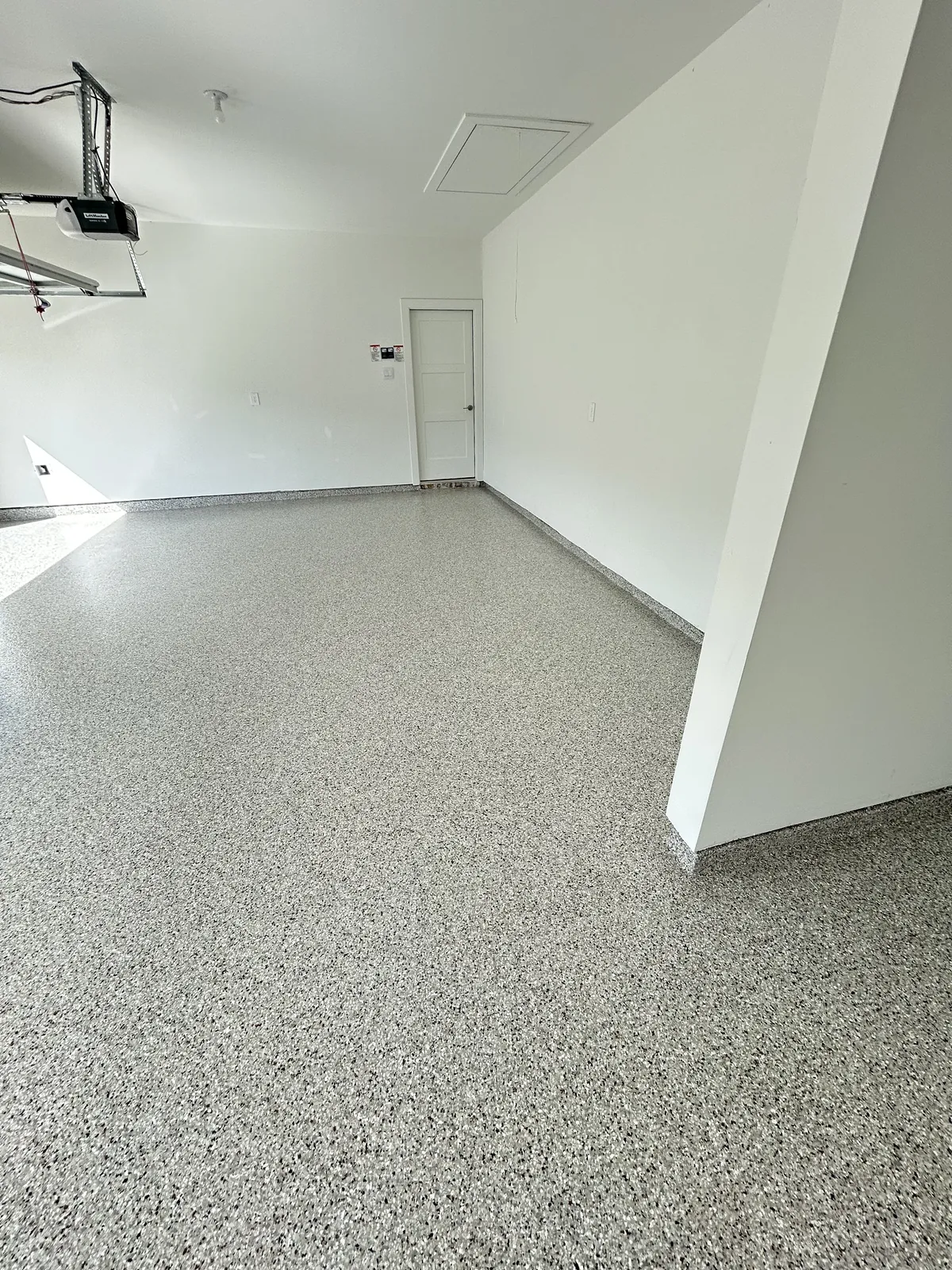
Your lights change the blend
A flake blend is a mix of colored vinyl chips, often several colors in one bag, and every one of those colors shifts with the light. Cool white LED shop lights push a blend toward gray and blue. Warmer bulbs pull it toward tan and cream. Sunlight through an open garage door does something else again, and it changes from morning to evening.
That is why we would rather settle color standing in your garage than over the phone. At the visit we talk through blends right there, with the door open and then closed and the lights on, near the spot where the car parks and near the back wall where it is darker. Seeing how your own light falls on the slab narrows the choice faster than any photo.
Pay attention to the darkest corner. Most garages have a back wall or a spot behind the water heater that never gets much light, and a dark blend can look almost black there. If that corner is where the shelving and the freezer live, a lighter blend keeps it from feeling like a cave.
Five feet away, it reads as one color
Up close, a flake floor is a scatter of separate chips. Stand up straight and it blends into one overall tone, a little like gravel or granite seen from across a room. People often fall for a blend at arm’s length because of one bright chip color in it, then find that color barely shows from standing height.
So judge a blend from where you will actually see it: standing, walking in from the house, getting out of the car. Settle the overall tone first, and let the accent colors in the mix decide the character up close. A few questions sort most people out quickly:
- Warm or cool overall
- Lighter or darker than the walls
- How much dirt comes in on the tires
- Gloss or satin over the top
Full broadcast or a scattered look
Most garage floors get a full broadcast, where we throw chips into the wet base coat until no base shows through, then scrape and vacuum off the extra. The finished floor is all chip, which gives the best texture under the topcoat and hides the most dirt. You can read how those layers go together on our garage flake systems page.
A partial broadcast scatters chips more lightly, so the base coat color shows between them. That turns the base into part of the design: a gray base with sparse black and white chips looks very different from the same chips on a tan base. It is a cleaner, more modern look, and it shows dust, tire marks and sawdust sooner, because more of the floor is one flat color.
Repaired cracks show more on a scattered floor as well, since filler under a thin spread of chips can read as a faint line. On a hard-working garage we usually steer people toward full broadcast and save the scattered look for a hobby room or a covered porch.
Matching the house, not a photo
Photos are a fine starting point, and you can see finished floors in our gallery. Keep in mind that every phone camera and every screen shifts color, and a photo of a blend in someone else’s garage is really a photo of their light. Use photos to pick a direction, a gray family or a brown family, and leave the final call for the room.
Then look at what lives in the garage. Wall paint, cabinets, a brick wall, the trim on the door and even the cars parked there all sit beside the floor. A blend with a little of the wall color in it ties the room together. A blend that fights the cabinets will bother you every time you open the door. If you might sell the house in a few years, a neutral blend in grays or tans tends to suit more buyers than a bold one.
The number of colors in a blend matters for more than looks. A busier blend with three or four colors hides a stray chip, a filled pinhole or a scuff far better than a two-color mix, and those small marks are what a garage floor collects over years of use.
What the topcoat does to color
The clear topcoat changes a blend more than most people expect. A gloss topcoat deepens every chip and makes the floor read darker and richer, a bit like a stone pulled out of a creek. A satin finish leaves the colors softer and lighter, closer to how the dry chips look, and it hides fine scratches better. Knowing that helps people decide whether they want shine or a quieter floor.
Gloss has a practical side too. It shows dust, footprints and mop streaks more than satin does, especially under bright overhead lights. In a garage that doubles as a workshop or a home gym, satin is often the calmer choice.
Over time, the topcoat also decides how well the color holds. A UV-stable topcoat keeps chips near an open door from yellowing in the sun, which matters most on light blends, where yellowing shows first. Our decorative flake page covers where else chip floors work around a house.
One blend across two rooms
If the garage opens into a laundry room or a mudroom, or a porch sits right outside the side door, you might want the same blend running through. That can look great, but the light in each space is different, so the same blend will look a little different in each one. Pick the blend for the room you will see most and expect the others to read slightly warmer or cooler.
Outside spaces are the exception worth thinking about. A porch in full sun gets hot, and a lighter version of the garage blend often makes more sense there than an exact match.
Doorways need a clean stopping point. Where one blend ends at a threshold, we finish it on a straight line under the door so the change from one room to the next looks planned.
Changing your mind after the visit is fine. Most people do, at least once. Call or text (936) 445-0702 with what you are leaning toward, and we will talk it through before the floor goes down.
Questions
Do dark blends make a garage feel smaller?
They can. A dark floor under dim lights pulls the room in, while a lighter blend bounces light around and makes the walls feel farther apart. Better lighting changes this a lot, so judge the space with the lights you actually use.
Will the flake colors fade?
Under a UV-stable topcoat, flake colors hold up well indoors. Floors that get direct sun through an open door see the most change, and light blends show it first. The topcoat is the layer that protects them.
Can the garage and the porch have different blends?
Yes. Many people use a lighter blend outside, where it stays cooler underfoot, and a darker one inside. We make sure the topcoat on the porch suits sun and rain.
Does chip size change how a blend looks?
It does. The same colors read as a fine speckle in small chips and as a bold pattern in large ones. Most garage blends mix sizes, which lands somewhere in between.
We look at the slab and read its moisture before anyone picks a finish. Call or text (936) 445-0702, email procoatepoxyflooring@gmail.com, or see the gallery first.