
A garage slab that stands up to hot tires
Park a car that just came off a summer highway and its tires are hot enough to soften a weak coating, then pull it up when you back out. Garage floors fail in ways no other room does, so we build them around the tires and the oil drips first and the color second.
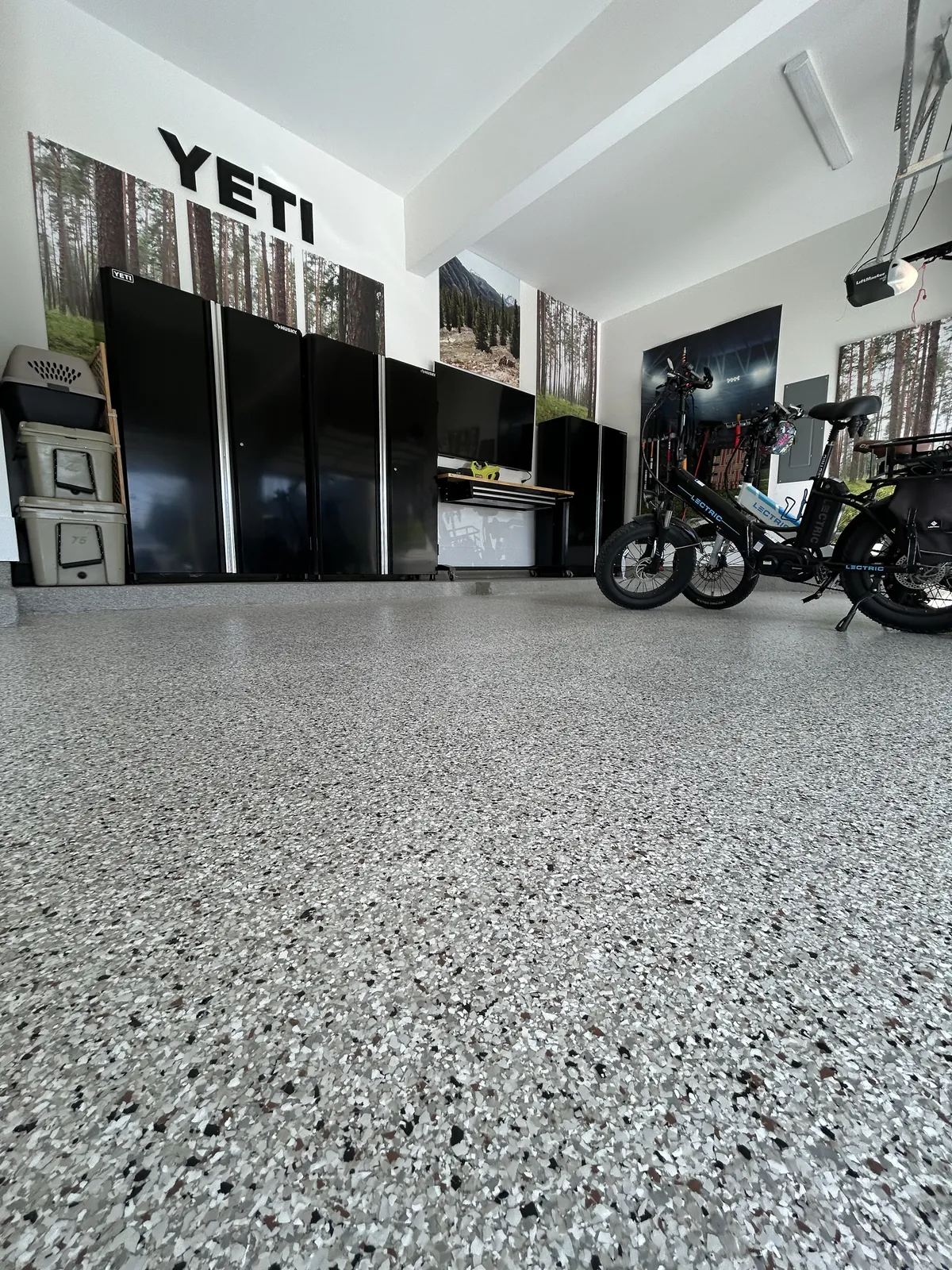
Hot tires and coatings that lift
Tires get hot on a Texas road in summer. Park on a coating that’s thin or poorly bonded and the rubber softens it and grips it, and when you back out the next morning the tire pulls a patch of coating along. The bare spot collects grit, and every trip in and out makes it bigger.
One-part garage floor paint and many store-bought kits sit on top of a smooth slab with nothing to grip. We grind the concrete open first, prime it so the resin soaks in, and build a body coat with real thickness under a hard topcoat.
Rubber is worth one more note. Some tires and rubber-backed mats leave brown stains in a coating over time as chemicals in the rubber work their way out. A good topcoat resists it, and a mat with a woven or plastic backing avoids it.
Hot tire pickup is almost always a bond problem.
Oil that’s already in the concrete
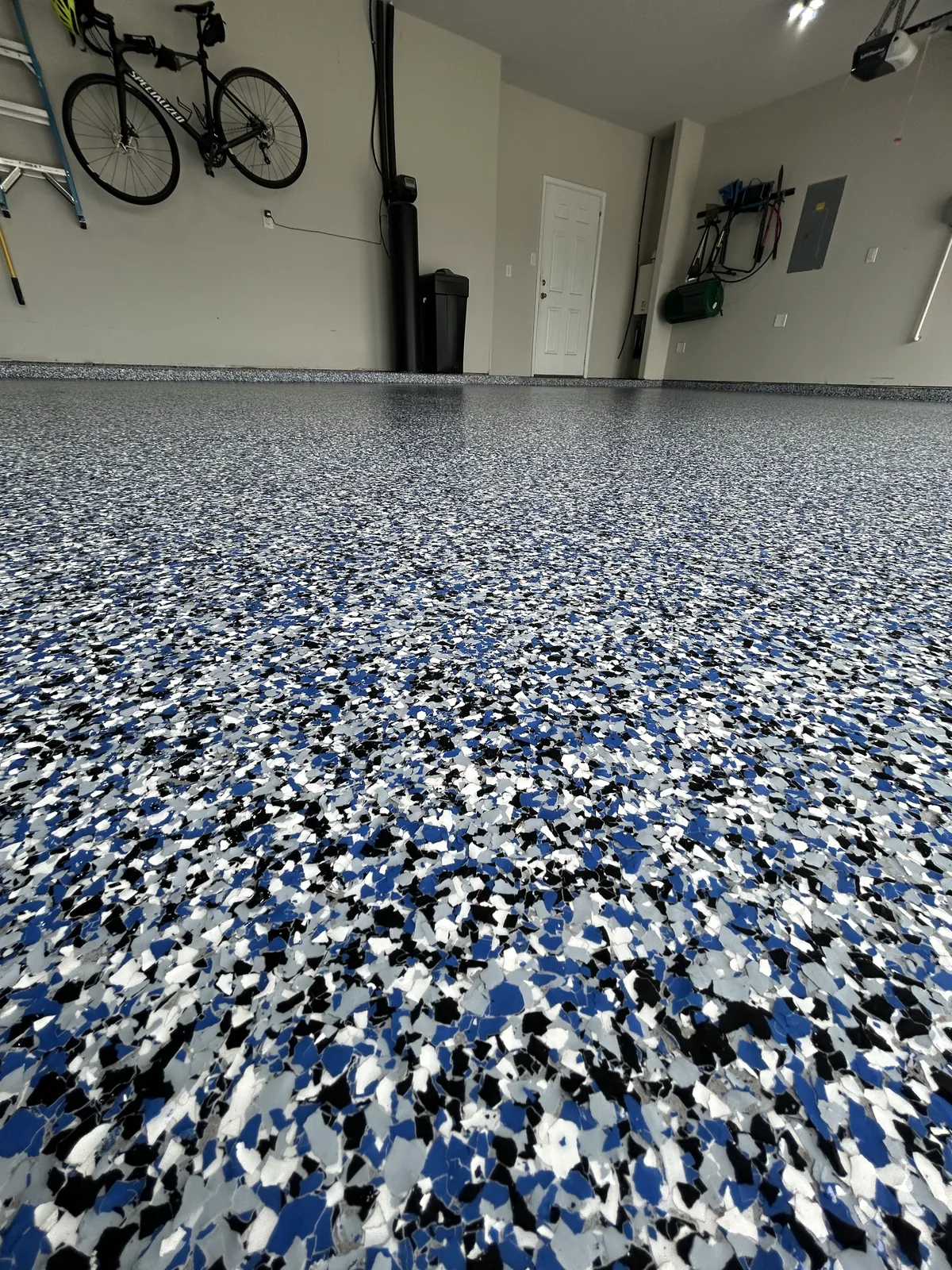
Most garages we look at already have oil in them: a dark spot under the engine, a ring where the mower sat, transmission fluid by the door. Brake fluid and spilled gas from weekend projects end up in the slab the same way. Concrete soaks that up, and oil sitting below the surface keeps working back up and breaks the bond of any coating laid over it.
So oil spots get degreased, then ground, then checked again. Grinding takes off the stained top layer, and on most spots that’s enough. A slab that’s been soaking for years can keep bleeding oil after grinding, and we’ll tell you at the assessment if a spot needs extra treatment or a cut-out and patch. Coating over a spot that’s still bleeding oil can leave a soft, lifting patch in the new floor.
How a garage slab differs from the house
A garage slab is poured to slope toward the door so water runs out, and it usually sits a step below the house. There’s often a joint at the door where the slab meets the driveway apron. The coating has to run right to that edge and stop cleanly, because that’s where rain and road grit hit hardest. Some garages also have a floor drain, and the coating has to finish neatly at its edge.
The door edge also gets direct sun whenever the door is up. Plain epoxy ambers in sunlight, so the strip by the door can turn yellow before the back of the garage does. A UV-stable polyaspartic topcoat keeps the color even from the door to the back wall. Yellowing shows first on light colors, so a white or light gray garage needs that topcoat most.
What to know first
- Looks like
- A hard coated slab, most often with color flake broadcast into it, that hides tire marks and wipes clean.
- Holds up in
- Attached and detached garages and drive-in workshops where cars park, drip and get worked on.
- Wrong pick when
- A garage slab that pushes heavy moisture and can’t take a moisture-mitigating primer is better sealed than coated.
- Prep it needs
- Oil stains get degreased, the whole slab gets diamond ground open, and cracks and the chipped edge at the door get repaired.
- Compared with
- People compare it to garage floor paint, which tends to peel under hot tires, and it often gets a polyaspartic topcoat for the sun at the door.
Is garage floor epoxy coatings right for your floor
A good fit
- A two-car garage with oil spots and a dusty bare slab.
- A garage that doubles as a shop or a home gym.
- Old garage paint that is peeling under the tires.
- A newer house where the garage slab has never been coated.
Where we steer people elsewhere
- A carport open to rain on every side usually does better with a penetrating sealer.
- A driveway in full sun needs a driveway coating built for outdoor concrete.
- A garage you only want dust-free, with no color, may just need a densifier and sealer.
What a garage coating job looks like
Empty and look
The garage gets cleared, cars and all, and we look over the oil spots, cracks and any old paint. We also check the door joint and the step up into the house.
Degrease and test
Oil spots get degreased so the grinder doesn’t just smear them around. Then we take moisture readings across the slab, since a garage slab can run wetter than the house slab next to it.
Grind it open
We diamond grind the whole floor and the edges along the walls. Old paint and loose coating come off in this step.
Patch and prime
Cracks, pitting and chipped edges at the door get filled. Primer soaks into the freshly ground concrete so every coat after it has something to hold.
Coat and topcoat
The body coat goes down, with flake broadcast in if that’s the finish you chose. A hard, UV-stable topcoat seals it and takes the tires.
Part of Flake Epoxy Systems
Garage Floor Epoxy Coatings is one of the services under flake epoxy systems. The overview compares them all.
- Garage Floor Coatings
The garage is the floor we are asked about most, and the one that punishes a shortcut fastest.
- Garage Floor Flake Systems
The layered chip floor built for a garage, from base coat and broadcast to scraping and topcoats, with a blend that suits the house.
- Garage Floor Epoxy
The full garage system explained: how it differs from a kit, what the days on the job look like, and moving back in afterward.
- Polyaspartic Garage Floors
Choosing a polyaspartic system for a garage that gets afternoon sun at the door or needs to be back in use sooner.
Asked and answered on garage floor epoxy coatings
Ask us directly: call or text (936) 445-0702 or write through the contact page.
Why did my garage floor paint peel?
Usually because it never really bonded. Paint rolled onto a smooth, unground slab sits on top, and hot tires or trapped moisture lift it off. All of it has to come up before a new coating goes down, or the new floor peels along with it.
How long before I can park in the garage again?
Longer than you can walk on it. A car is heavy and its tires turn on the surface, so the coating has to cure further before the car comes back in. The product and the garage temperature set the time, and we’ll give you a day for your floor.
Is flake the only option for a garage?
No. Flake is the most common pick because it hides dust, tire marks and small stains, but solid color, quartz and metallic pours go in garages too. Solid colors show more dirt, so they suit a garage that doubles as a clean shop.
Is it slippery when the car drips rainwater?
A smooth topcoat can be slick with water on it. Flake adds some texture on its own, and we can mix fine grit into the topcoat for more grip. Near the door, where rain gets tracked in, the extra grit is usually worth it.
Do you coat the step and the door edge?
We can coat up the step into the house, and the coating runs to the garage door and stops at the joint. We don’t run garage epoxy out onto the driveway apron, since that’s outdoor concrete with different needs.
Can a garage floor be coated in summer heat?
Yes, with some care. Heat shortens the working time of most coatings, so we plan the work for cooler parts of the day and mix smaller batches. A hot slab in afternoon sun at the open door gets extra attention.
Get the garage floor looked at
Text us a photo of the garage floor or call (936) 445-0702 to set a time. We’ll come check the oil spots and the moisture and tell you what the slab needs.
- Call or text(936) 445-0702
- Emailprocoatepoxyflooring@gmail.com
- Based inConroe, Texas, working six counties
Want to see the work first? Browse the gallery, or find every way to reach us.