
Richmond’s older slabs, close to the Brazos
Storefronts in the old town center and houses near the Brazos River give Richmond, the Fort Bend County seat, a lot of floors with a past. A lot of the concrete here has been around a while, painted or covered over the years and patched more than once, and some of it sits on ground that stays damp after a big rain.
Floors painted more than once
Garage floors, storerooms and back rooms in older buildings are often painted, and often more than once. Floor paint was never meant to take hot tires or dragged shelving for long, so it lifts in sheets near the door and wears through in the paths. Each new coat went on over the last one, which means the whole stack is only as strong as the bottom layer’s grip on the concrete.
We don’t coat over paint. It comes off first, usually with diamond grinding, and on a thick stack sometimes with a chemical stripper to soften it first. Underneath, old paint often hides patching, oil that soaked in before anyone painted, and cracks that were filled with whatever was on hand. All of that gets dealt with once we can see it.
In a building old enough that the paint may contain lead, we talk about testing it before any grinding starts. We raise it at the assessment, well ahead of the job, since it can change how the removal is done and how the dust is handled. If the test comes back clear, the grinding goes ahead the usual way, with dust collection on the grinder.
So the moisture test carries real weight in Richmond.
Living close to the river
The Brazos runs past Richmond, and the low ground along it is floodplain. Homes and buildings near low ground can see water sit in the yard or creep under a door in a heavy storm, and a slab that soaks up water holds it for a while. Concrete gives moisture back slowly, as vapor rising through the slab, and that vapor is what pushes a coating off from underneath.
We take readings before we suggest any system, and if they come back high the floor gets a moisture-mitigating primer, which is built to hold down vapor that a standard primer would let through. If a slab is still drying out after water got in, we would rather wait and test again than coat it early.
We are plain about what a floor can do. No coating or sealer keeps floodwater out of a house, because the water comes in under doors and through walls. What a good coating does is give you a floor that cleans up after muddy water instead of soaking it in. On patios, driveways and walkways, a penetrating waterproofing treatment cuts down how much rain the concrete drinks. Those treatments soak in and leave the surface looking close to how it did, so a front walk keeps its grip.
Old concrete with stone near the surface
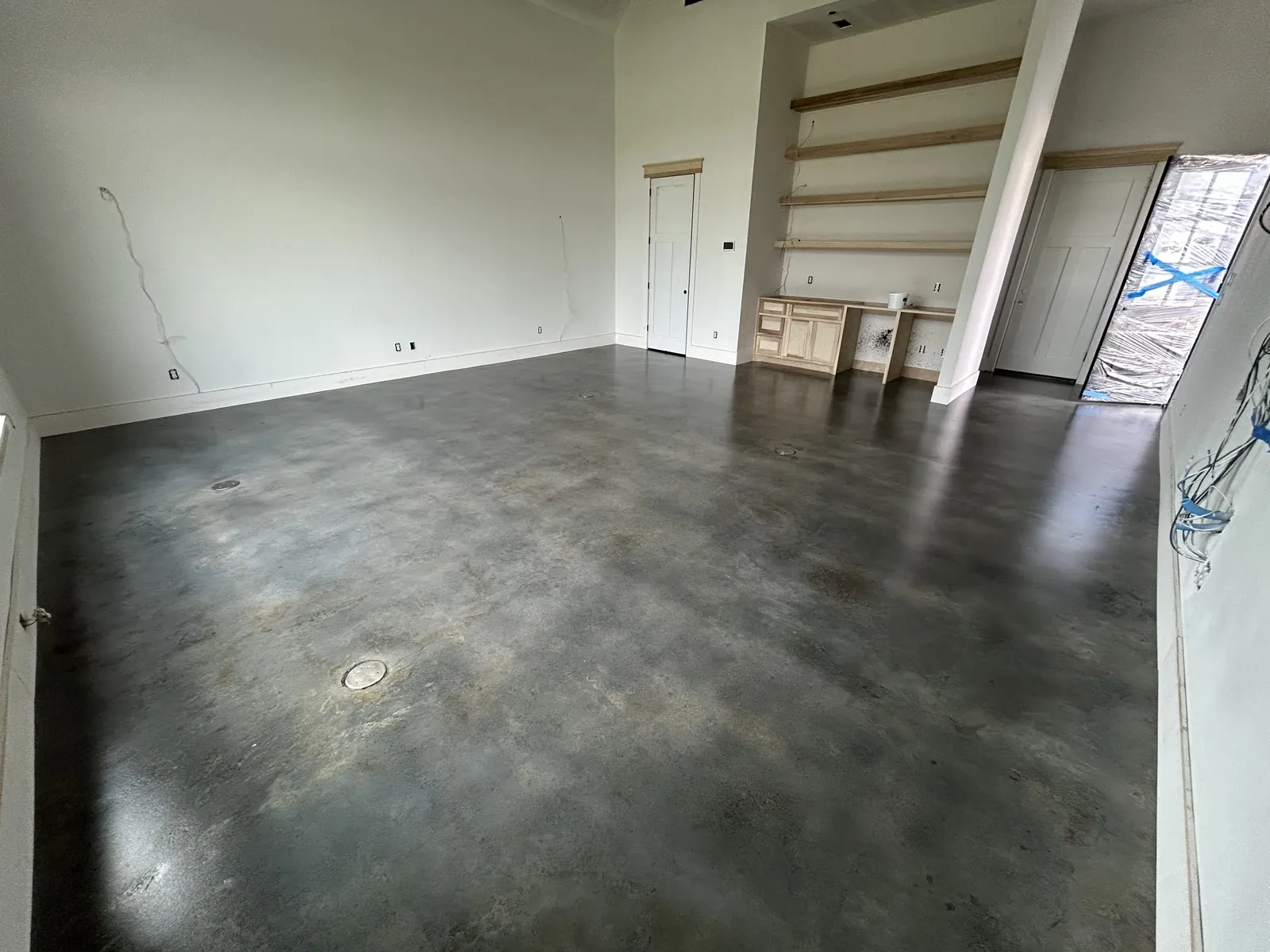
All concrete has stone mixed through it, and on an older slab with a worn top that stone can sit a short grind away. Cut down into it and polish, and the floor shows a scatter of pebbles and broken rock in the gray, which suits older storefronts and homes where a bright new coating would look out of place. How much stone shows, and how evenly, depends on the mix and how the slab was finished, so we grind a small test spot in a corner before anyone commits.
Where an old slab is too scarred for that, a decorative coating can cover it while still reading as concrete: a thin cement-based or resin layer, troweled or sprayed, in a texture and color that fits the building. Front porches are a good fit too. They take rain and afternoon sun, so the system gets a UV-stable top and a little grit, and spalled edges get rebuilt before it goes down. On a porch we also check how water drains off the edge, since a coating cannot fix a slab that tilts toward the house.
Floors that suit Richmond
Four we would put on the shortlist here, before we have seen your slab.
I have a long concrete porch that runs along my workshop. The old surface coating on it was an eyesore. The new flake epoxy flooring that Matt and his team applied looks awesome. It is obvious that they know their products and how to apply it properly.
Chris, Google review
- Concrete Paint Removal
Painted garages and back rooms in older buildings need every layer of paint ground off before a new coating goes down, because new resin over old paint fails wherever the paint lets go.
- Concrete Waterproofing
Patios, driveways and walkways on low ground near the Brazos drink less rain with a penetrating waterproofing treatment, which keeps the surface breathable instead of trapping water under a film.
- Exposed Aggregate Polishing
An older slab with a worn top can be ground down to its stone and polished, a finish that fits older storefronts and homes better than a bright coating.
- Decorative Concrete Coatings
A scarred slab or a tired front porch can take a thin decorative layer in a texture and color that still reads as concrete, with a UV-stable top outdoors.
More towns in Fort Bend County
The Fort Bend County page lists every town we cover there.
- BeasleyUS 59, rural
- Sugar LandUS 59, southwest
- RosenbergUS 59, next to Richmond
- FulshearNorthwest Fort Bend
Richmond floor questions
Ask us directly: call or text (936) 445-0702 or write through the contact page.
My house is near the Brazos. Can my floor still be coated?
Usually, yes. Being near the river does not rule a floor out, but it does make the moisture reading the deciding number. A dry slab gets a standard primer, and one that reads high gets a moisture-mitigating system before the rest goes on. If the floor took on water recently, we wait for it to dry and test again.
Can you coat over old patches in the slab?
Usually. We tap every patch, and the ones that sound hollow or crumble at the edges get cut out and redone with a repair material made for coatings. Sound patches can stay. Under a solid or flake coating they disappear, but under a stain or a polish they will still show, so they count when you pick a finish.
How many coats of paint can you grind through?
The number of coats matters less than how soft and thick they are. Thin, brittle paint grinds off quickly. Thick or rubbery layers gum up the diamonds, so on those we may soften them with a stripper first and then grind. Either way it all comes off, and we tell you at the assessment which way your floor will go.
How can I tell if my slab would look good with the stone showing?
From the top, you can’t, and neither can we. The only way to know is to grind a small test spot, somewhere out of the way like a closet corner or behind where a cabinet will sit, and look at what comes up. Some slabs show plenty of stone and some show mostly sand, and the test tells you which one you have before you commit.
Can a decorative coating go on an old front porch?
If the porch slab is sound, yes. We look for spalled edges, old paint and cracks where the porch meets the house, since those get repaired or removed first. Outdoors the coating needs a UV-stable topcoat so it holds its color, and a little texture so it isn’t slick when the rain blows in.
Start with the oldest floor on the property
Call or text (936) 445-0702 and tell us what’s on the floor now (paint, glue or bare concrete) and how close it sits to low ground. We’ll come out to Richmond, take readings and tell you what has to come off before anything new goes down.
- Call or text(936) 445-0702
- Emailprocoatepoxyflooring@gmail.com
- Based inConroe, Texas, working six counties
Want to see the work first? Browse the gallery, or find every way to reach us.