
South Houston slabs that take sun, grease and solvent
South Houston is its own small city, ringed on every side by Houston and sitting close to Hobby Airport. In Gulf Coast heat and humidity, three kinds of slab are hard on any finish: an open carport, a commercial kitchen and a bay where paint and solvent get spilled.
Carports that weather like a patio
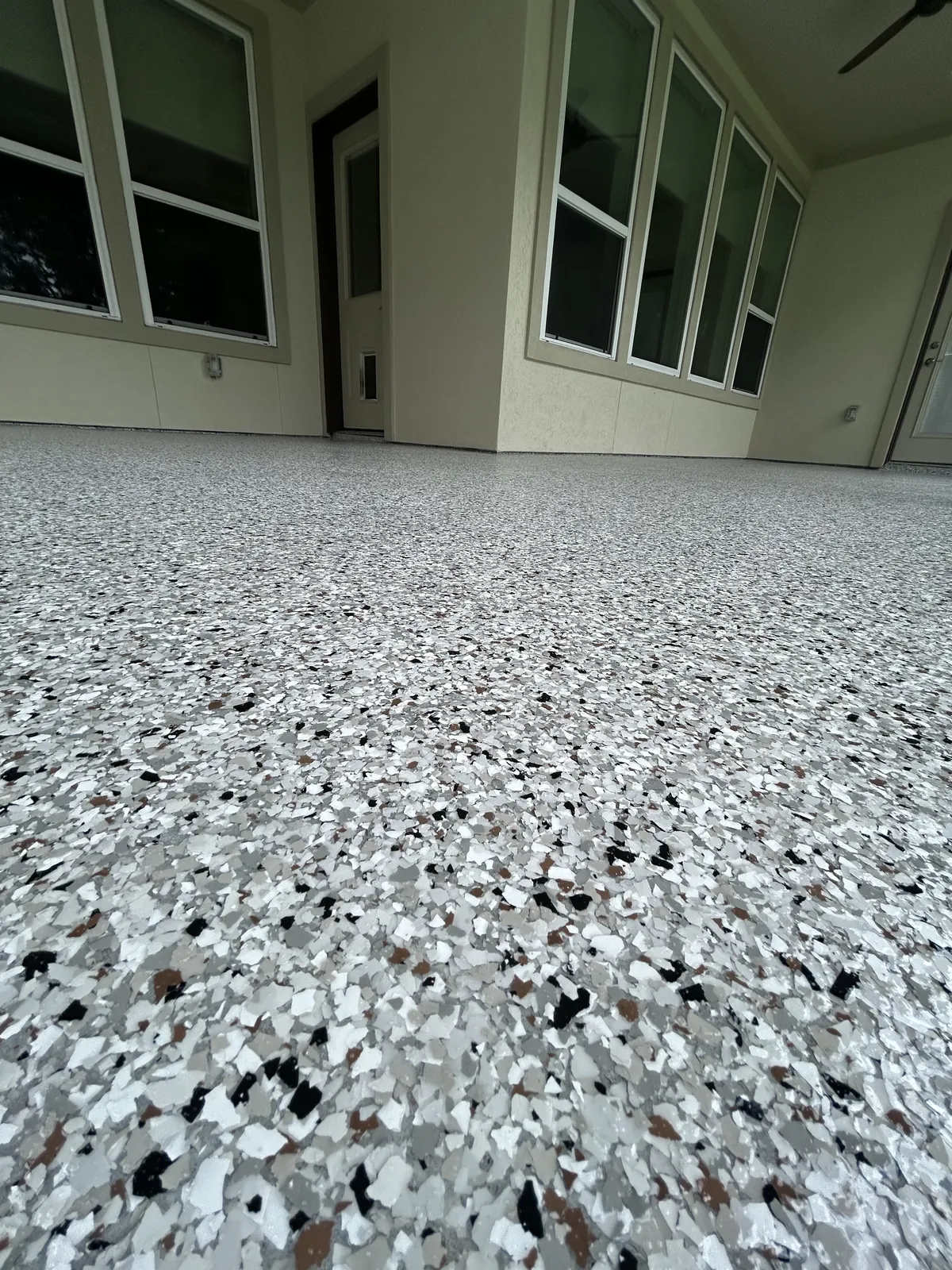
A carport slab is outdoor concrete with a roof over part of it. Rain blows in from the open sides and the afternoon sun slides under the edge of the roof. Then the car pulls in hot from the road every evening. Where it is the only covered spot on the lot, the carport often doubles as the place where the grill, the bikes and the trash cans live, so it collects a mix of grease, rust rings and tire marks that soak straight into bare concrete.
That mix is why we steer carports away from plain epoxy. Epoxy ambers in sunlight, and the strip by the open side would turn yellow while the part under the roof stayed put. A polyaspartic system holds its color outside and cures much faster, which matters when the carport is the only covered parking the house has. We grind the slab first, since an old carport has often been sealed or painted at some point, and either one leaves a film a new coating cannot grab.
Older carport slabs also tend to have settled at the edges, where the clay under them dries out in a hot summer and swells again after the storms. A crack along the front edge, or one running back from a roof post, is the usual sign. We open those cracks up, fill them and grind them flush before any coating goes down, because a coating laid over an open crack just shows the crack in a new color.
Grit broadcast into the topcoat keeps the floor from getting slick when it is wet.
Back-of-house floors behind the counter
A small restaurant kitchen is one of the hardest rooms a floor can be put in. Hot water and degreaser hit it every night at closing. All day, grease settles under the fryers and cooks in wet shoes move fast between the line and the walk-in. Quarry tile is common back there, and the grout lines are where it goes wrong: they wear down, crack and start holding grease and water that never fully dries.
Plain epoxy is the wrong floor for that room. Hot water washdowns and the heat from cooking equipment can soften or crack it over time, and once it lifts at a drain the water gets under it. Polyurethane cement is built for this. It takes the shock of hot water better than epoxy and goes down thick and seamless, and we can cove it up the wall a few inches so there is no corner where floor meets base for grime to pack into.
Kitchens cannot close for long, so the schedule matters as much as the product. We look at the drains, the slope to them and the condition of the slab under the old tile before we talk about timing, since tearing out tile sometimes turns up soft or broken concrete that has to be repaired. The usual plan is one push: the old floor comes out, the slab gets ground and patched, and the new system goes down. We tell the owner at the assessment how many days the room will be out of use and when the equipment can roll back in.
Floors where paint and solvent spill
A bay where cars get sanded and painted makes a mess most floors never see. Overspray settles on the floor around the booth and sanding dust gets ground in by every pair of boots. Then there are the thinners and reducers spilled while someone mixes paint or cleans a gun. Bare concrete soaks all of it up, and a cheap floor paint softens the first time a solvent sits on it. Add a car up on stands or a frame machine bolted to the slab and the floor also takes point loads that crack a thin coating.
For a bay like that we look at a chemical-resistant system over a slab that has been ground or shot blasted to a good profile. The topcoat is the part that has to stand up to solvent, so we match it to what actually gets spilled in that shop, and a light gray or white base makes the room brighter and shows a dropped clip or a puddle right away. Around frame anchors and drains we work the edges by hand so the coating does not chip where it meets metal, and the booth floor gets a product that can be scraped clean without lifting.
Floors that suit South Houston
Four we would put on the shortlist here, before we have seen your slab.
Matt and his guys did an amazing job today and yesterday. Communication was great, service was awesome, and finished product looks amazing!
Austin Colson, Google review
- Restaurant Kitchen Flooring
Small kitchens with hot washdowns, fryer grease and floor drains need a seamless floor coved at the walls, with grit so wet shoes hold.
- Automotive Shop Flooring
Paint and repair bays need a ground slab under a solvent-resistant topcoat, in a light color that shows spills and dropped clips.
- Polyaspartic Floor Coatings
Carports catch sun and blown-in rain, so a UV-stable polyaspartic that cures quickly keeps the only covered parking spot out of use for less time.
- Garage Floor Repair
Edge cracks are common where clay moves under an older slab, and those cracks get opened, filled and ground flush before any color goes down.
More towns in Harris County
The Harris County page lists every town we cover there.
- Galena ParkOn the Ship Channel
- Jacinto CityNext to Galena Park
- WebsterClear Lake, I-45
- AldineNorth Houston
Your South Houston floor questions
Ask us directly: call or text (936) 445-0702 or write through the contact page.
Can a carport slab get the same coating as a garage?
It can, but we usually change the topcoat. A carport is open to sun and rain, so it needs a UV-stable top such as polyaspartic, or the strip nearest the open side will yellow. We also add some texture, since a carport floor gets wet every time it storms.
Can you coat over quarry tile in a kitchen?
Usually not. Grout lines that have soaked up years of grease make a poor base, and a tile that is loose underneath will crack whatever goes over it. We take the tile up, repair the slab underneath and lay the new floor on clean concrete.
Will paint thinner damage a coated shop floor?
It depends on the topcoat. Many standard epoxies soften or stain when a strong solvent sits on them, while chemical-resistant topcoats are made to hold up long enough for a spill to be wiped. Tell us which products get used in the shop, and we pick the system around them. Wiping spills soon still matters on any floor.
Does a small, older slab need moisture testing too?
Yes. Age does not stop vapor from coming up through a slab on grade, and in the Gulf Coast humidity a floor that looks dry on top can still be pushing moisture from below. The reading at the assessment tells us if the floor needs a moisture-mitigating primer. Skipping it is a common reason a coating blisters later.
How long will a restaurant kitchen be closed for the floor?
That depends on the size of the room, what has to come up first and which system goes down. Old tile and broken concrete underneath add time, and a sound slab saves it. We set the schedule at the assessment, once we have seen the drains and the concrete, and we plan the start around the night you close.
Tell us which floor is giving trouble
Call or text (936) 445-0702 with the address and whether it is a carport, a kitchen or a shop bay. We will come out to South Houston, test the slab and tell you what we would put down and how long the space would be out of use.
- Call or text(936) 445-0702
- Emailprocoatepoxyflooring@gmail.com
- Based inConroe, Texas, working six counties
Want to see the work first? Browse the gallery, or find every way to reach us.