
Service bay floors that take jack stands and brake fluid
A service bay gets more thrown at it than almost any floor we coat, from cars rolling in hot off the freeway to brake fluid dripping off a caliper. We build shop floors around the lifts, the drains and the chemicals your techs use every day, then grind the slab so the coating has something to hold.
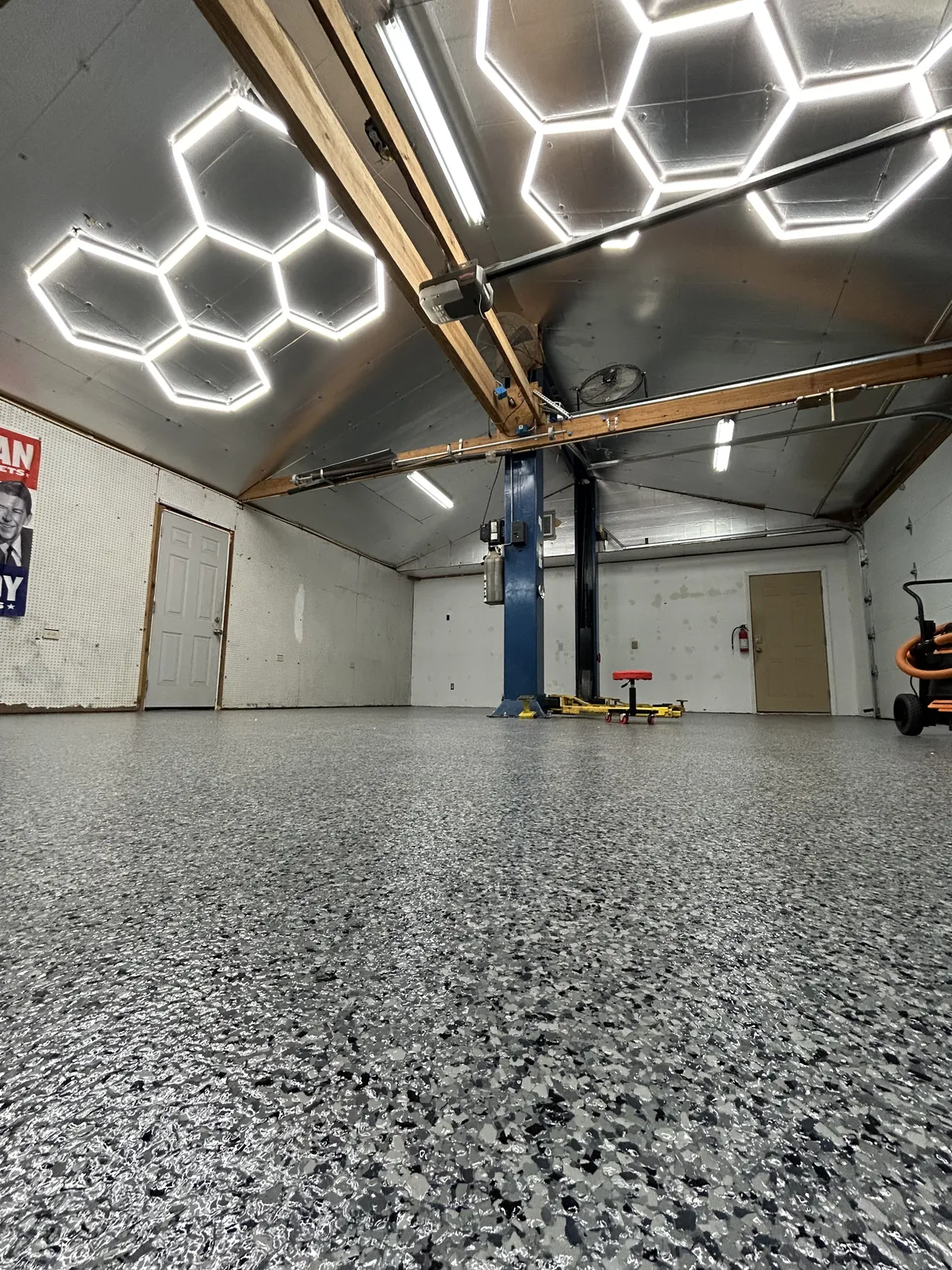
Lifts, jack stands and point loads
A two-post lift puts the weight of a truck onto a few anchor bolts and a pair of base plates. The concrete under those plates has to be sound, and the coating around them has to be sealed tight so oil and water don’t work under the edge. We grind and coat up to each lift base and leave the anchors alone. When a lift is being replaced, that’s the time to fill the old anchor holes and coat the concrete where it stood.
Jack stands are the harder test. A thicker system with a tough topcoat holds up much better, and pads under the stand feet help any floor.
Creepers, rolling toolboxes and floor jacks add wear of their own. Their wheels are small and hard, and a floor jack dragged across the bay on a gritty wheel will scratch any topcoat. On a well-built floor those scratches are mostly cosmetic, and a flake pattern hides most of them.
A loaded stand puts a car’s weight on a few small feet, and a tech sliding one into place can scrape right through a thin coat.
Brake fluid, solvents and the drain

Brake fluid is one of the hardest things a shop spills on a coated floor. Most brake fluid is glycol based, and it can soften or stain a coating that wasn’t chosen with it in mind. Brake cleaner and parts-washer solvent do their own damage when they sit. We ask what your techs spray and spill, then pick a topcoat that holds up to those long enough to wipe them away.
Floor drains and trench drains collect all of it. We repair the concrete at the drain edges, carry the coating down into the lip and keep the floor running toward the drain, so fluid doesn’t pool in a corner of the bay. If the slab pitches the wrong way, we correct it with grinding or leveling before any coating goes on, since the coating will copy whatever slope is already there.
Tires that come in hot
Customer cars roll into the bays straight off hot Texas roads, and they do it all day. A hot, soft tire parked on a poorly bonded coating can grab the surface and pull it up as it cools. A shop goes through that cycle far more often than a home garage, so we build the bays on ground concrete with a well-bonded body coat and a topcoat that handles the heat.
Tire marks are a separate problem. Rubber leaves black scuffs where cars turn onto the lift, and some tires can leave a yellowish stain as chemicals in the rubber move into the coating. A flake floor hides most scuffs between cleanings, and a good topcoat lets them scrub off instead of setting in. A plain light gray floor shows every one.
Automotive Shop Flooring at a glance
- Looks like
- A broadcast flake floor, usually in light grays, that hides tire scuffs between cleanings while still showing a dropped bolt or a fresh drip.
- Holds up in
- Repair shops, quick lube and tire shops, dealership service departments and fleet maintenance bays with lifts, floor drains and parts washers.
- Wrong pick when
- If the bays only park vehicles and see no fluids, a penetrating sealer or polished concrete may be all the slab needs.
- Prep it needs
- Diamond grinding to an open profile, oil-soaked spots cleaned or cut out, cracks and drain edges repaired, and moisture tested before primer.
- Compared with
- Shop owners usually compare it with polished concrete, and many end up with a flake body coat under a chemical-resistant or polyaspartic topcoat.
Before you settle on automotive shop flooring
A good fit
- Repair bays with two-post or four-post lifts.
- A quick lube or tire shop with cars rolling in hot all day.
- Fleet maintenance floors that see brake fluid and parts cleaner.
- Bays with floor drains where fluid keeps pooling in the wrong spot.
Where we steer people elsewhere
- A wash bay that stays wet all day needs an anti-slip floor coating built for standing water.
- A detail studio that doubles as a showroom may want showroom flooring with more gloss.
- A bay used only to park vehicles may need nothing more than a penetrating concrete sealer.
Building a floor for working bays
Look over the bays
We look at each lift, drain and parts washer and the spots where fluids collect. We also ask what your techs spray and spill so the topcoat matches.
Degrease and test
Years of drips soak into shop concrete, so oil spots get degreased and the worst get cut out and patched. Moisture readings come next.
Grind to the lifts
We diamond grind the bays and hand grind around lift plates, anchors and drain edges. Dust collection runs the whole time.
Repair and slope
Cracks, spalls and broken drain edges get rebuilt. Low spots that hold fluid get leveled so the bay drains the way it should.
Flake and topcoat
The body coat goes down with flake broadcast into it, then gets scraped and topcoated in a resin chosen for your fluids. Grit goes in where the floor gets wet.
Bays back in order
Techs can walk on it first, then roll toolboxes, then bring cars in. We can do a few bays at a time so the shop keeps working.
Part of Solid Color Systems
Automotive Shop Flooring is one of the services under solid color systems. The overview compares them all.
- Heavy-Duty Industrial Flooring
The heaviest builds for dropped steel, steel wheels, point loads and abrasion that would wear through a standard coating.
- Heavy-Duty Protective Flooring
Tough builds for barns, farm shops, loading areas and rental yards where buckets, jacks and gravel do the damage.
- Anti-Static Flooring
Static-dissipative or conductive floors for electronics work and server rooms, grounded to the building and confirmed at the assessment.
- Seamless Resin Flooring
One continuous resin floor with an integral cove and no grout lines, for clinics, labs, restrooms and kitchens.
Asking about automotive shop flooring
Something else on your mind? Call or text (936) 445-0702, or use the contact page.
Will brake fluid ruin an epoxy floor?
It can if it sits. Glycol-based brake fluid softens or stains some coatings, which is why we choose the topcoat with your fluids in mind. Wiping spills up promptly still matters on any floor.
Can you coat around our lifts without pulling them?
Yes. We grind and coat up to the base plates and seal the edges, leaving the anchors where they are. If a lift is being replaced, give us the date so we can coat where it stood.
Do we have to close every bay at once?
No. We can work a few bays at a time and keep the rest of the shop running. Dust collection keeps grinding dust down, though the coating smell and noise mean the bays next door need some planning.
Do jack stands damage a coated floor?
A loaded stand dragged or dropped can scrape any topcoat. A thicker system holds up better, and pads under the stands help a lot. Small scratches in a flake floor mostly disappear into the pattern.
What color hides tire marks best?
A flake blend with some darker chips hides scuffs and tire marks better than a plain light color. The tradeoff is that small parts get a little harder to spot. Many shops pick a light flake blend with a few dark chips to get some of both.
What happens at the floor drains?
We repair the concrete around each drain, carry the coating into the lip and make sure the floor runs toward it. The coating edge at a drain is where water tries to get under, so it gets extra attention.
Tell us how many bays you run
Call or text (936) 445-0702 with the number of bays, the lifts and what your techs spill most. We’ll come test the slab and lay out a plan that keeps the shop working.
- Call or text(936) 445-0702
- Emailprocoatepoxyflooring@gmail.com
- Based inConroe, Texas, working six counties
Want to see the work first? Browse the gallery, or find every way to reach us.