
Needville’s barn slabs and shop floors on acreage
Needville is a small rural city in the south of Fort Bend County, and a lot of its concrete sits under the metal roofs of shops and barns out on acreage. Those slabs get used hard and rarely babied, so we look at how each building actually works before we talk about a coating.
Slabs poured under a metal roof
A pole barn or metal shop slab is often poured with less fuss than a house slab. Some go down without a vapor barrier under them, some get a broom finish so boots don’t slip, and many get no sealer at all. Years later the owner wants a floor that sweeps clean and doesn’t throw dust onto every tool, and that history decides what will stick. Before we decide anything, we want to know what the building was built for and what it does now.
A missing vapor barrier is the part we worry about most. With nothing between the slab and the clay, ground moisture can keep moving up through the concrete, and in wet stretches after summer storms it moves more. A coating laid over that can blister or let go in patches. So the moisture test comes before any talk of color, and on a damp slab we plan for a moisture-mitigating primer or steer toward a finish that lets the concrete breathe.
A broom finish needs its own thought. The ridges give grip, but they also hold dirt, and a thin coating rolled over them wears through on the high points first. We grind the ridges down so the coating sits on an even profile, then put the texture back with a broadcast or anti-slip grit in the topcoat. Wash bays and barn aisles that stay wet get a coarser grit than a dry tool room. You keep the footing and lose the dirt traps.
A floor that holds up under one of those can still fail under another.
What a working barn floor goes through
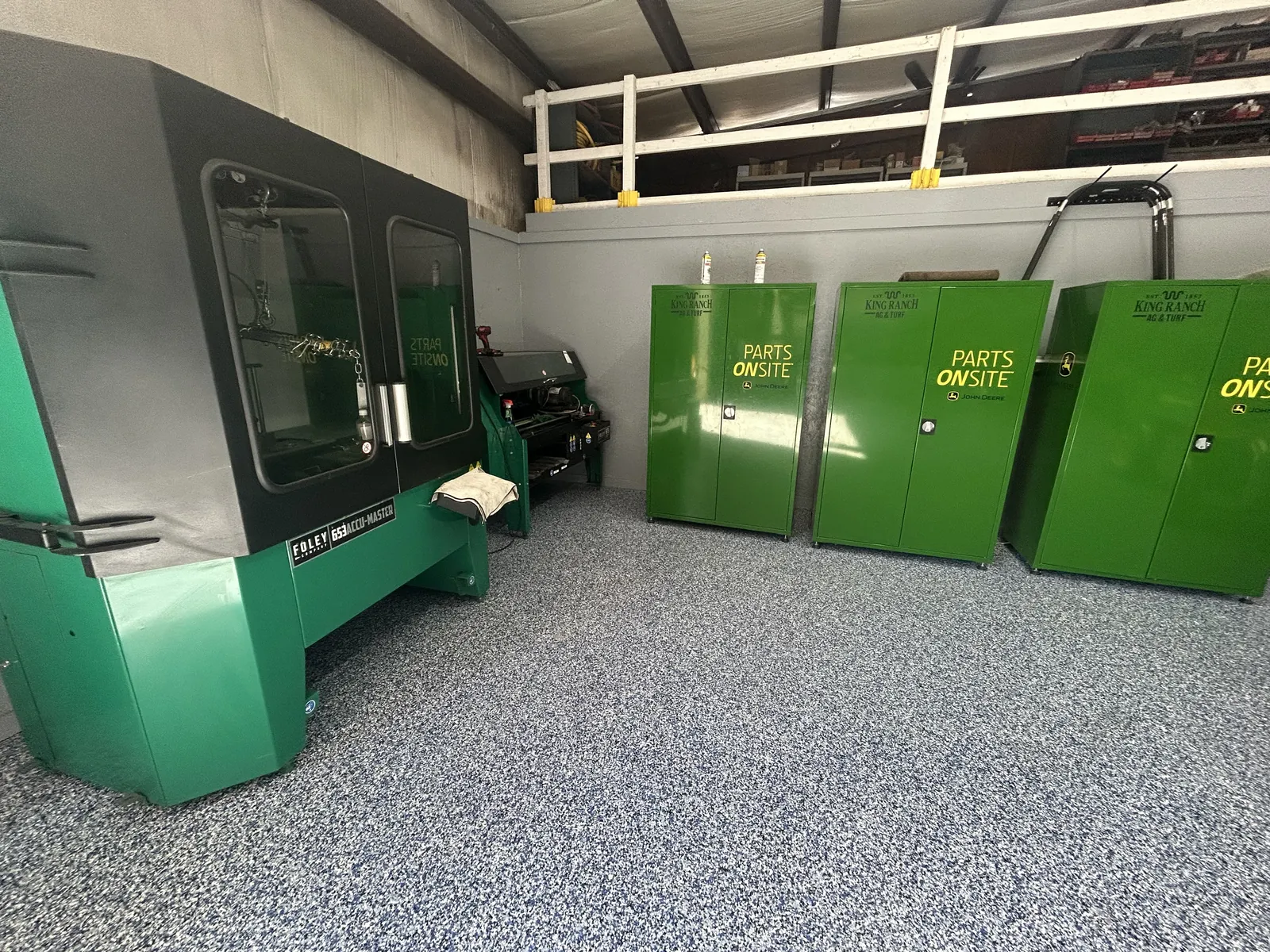
A shop on acreage rarely does just one job. The same slab might park a tractor with a loader, hold a trailer between hauls, and carry a welding bench and a parts washer along one wall. Each of those is hard on a floor in its own way: heavy point loads under jack stands, hot slag from the welder, diesel and hydraulic fluid dripping where the equipment sits.
For that mix we usually lean toward a thick, heavy-duty system over a thin decorative one. A ground slab, a primer, a body coat built up for impact and a chemical-resistant topcoat will take a dropped hitch better than a garage-weight floor. Where the welder works, we talk honestly about spatter: hot metal can mark any resin floor, so a welding blanket or a steel plate on that spot still makes sense. Lighter colors help here too, because a dropped bolt or a fresh drip shows up instead of hiding.
Sometimes the best answer is no coating at all. A barn that gets hosed out, sees muddy boots and parks equipment wet off the field may do better with a densified, sealed slab that has nothing on top to peel. A densifier hardens the surface and cuts the dust, and a penetrating sealer keeps fluids from soaking straight in. It is a plainer floor, and it is a lot harder to hurt.
Clay that shifts under outbuildings
The clay soil across this part of Texas swells when it gets wet and shrinks in a dry spell, and a big outbuilding slab rides that movement. Long cracks across a shop floor are common, and many of them open and close a little through the year. A rigid coating laid straight over a moving crack will usually crack again in the same line. Heavy loads parked in one spot for months can add to it, pressing on a corner of the slab that the soil underneath has already let down.
So we sort cracks before we fill them. A hairline that has stopped moving gets ground out and filled flush, and it usually disappears under the coating. A crack that is still working, or one that follows a control joint, often gets treated as a joint instead: we fill it with a flexible material and carry the line through the coating, so the floor has a place to move that does not tear the finish. Spalled edges along the joints get rebuilt with a repair mortar before priming.
Floors that suit Needville
Four we would put on the shortlist here, before we have seen your slab.
Very professional team. Amazing quality of workmanship. Would definitely work with ProCoat again!
James Howard, Google review
- Workshop Floor Coatings
A shop on acreage that holds a welding bench, a parts washer and a parked tractor needs a thick floor with a topcoat chosen for diesel and hydraulic fluid.
- Heavy-Duty Protective Flooring
Pole barns where loaders, trailers and jack stands put heavy point loads on the slab call for a body coat built up for impact, well beyond garage thickness.
- Concrete Densifier Application
A barn floor that gets hosed out and sees muddy boots can skip the coating entirely: a densifier hardens the surface and stops the dust with nothing on top to peel.
- Concrete Moisture Testing
Outbuilding slabs poured without a vapor barrier can push ground moisture up into a coating, so we take readings before choosing a primer or a system.
More towns in Fort Bend County
The Fort Bend County page lists every town we cover there.
- RosenbergUS 59, next to Richmond
- FulshearNorthwest Fort Bend
- Meadows PlaceOff US 59
- FresnoFM 521, new subdivisions
Floors in Needville, asked plainly
Not answered here? Ask us on the contact page or call or text (936) 445-0702.
Can a metal building slab with no vapor barrier be coated?
Often, yes, once we know how much moisture it is pushing. We take readings at the assessment, and if they run high we plan for a moisture-mitigating primer under the system. If the slab is very wet, a densifier and penetrating sealer may be the safer floor, since neither one traps vapor underneath.
Will a coated floor hold up to a tractor with a loader?
A thick system on a properly ground slab handles rolling tires and parked weight well. The trouble spots are steel: a bucket set down hard, a jack stand on a small foot, a hitch dropped on the floor. We build the body coat up for impact and suggest pads or plates where steel meets the floor every day.
Should a barn aisle that gets hosed down be coated at all?
It depends on how slick you can stand it. A coating sheds water nicely but gets slippery when wet unless it carries a good dose of anti-slip grit. Plenty of barn owners prefer a densified, sealed slab there, which keeps the natural grip of concrete and has nothing on it to peel.
What do you do with the long cracks across my shop slab?
We check whether each crack is still moving. Dormant cracks get ground out and filled flush with the floor. Active ones, and cracks that run along control joints, usually get a flexible filler and stay visible as a line in the finished floor, which beats a rigid patch that reopens a few months later.
Can welding spatter damage a coated floor?
It can. Hot slag lands hot enough to scorch or pit resin, the same way it marks bare concrete. We usually suggest a welding blanket or a steel plate under the bench. Everywhere else in the shop, the coating handles normal tool work fine.
Walk us through the barn
Call or text (936) 445-0702 and tell us what the building holds and how it gets cleaned. We’ll come out to Needville, look the slab over, take moisture readings and tell you which floor will hold up to your work.
- Call or text(936) 445-0702
- Emailprocoatepoxyflooring@gmail.com
- Based inConroe, Texas, working six counties
Want to see the work first? Browse the gallery, or find every way to reach us.