
Floors built for forklift wheels and chemical drips
Watch a loaded forklift turn in place at the end of an aisle and you’ll see where industrial floors give out. We build these systems around what rolls across the floor and what spills on it, then prep the slab well enough to hold the coating.
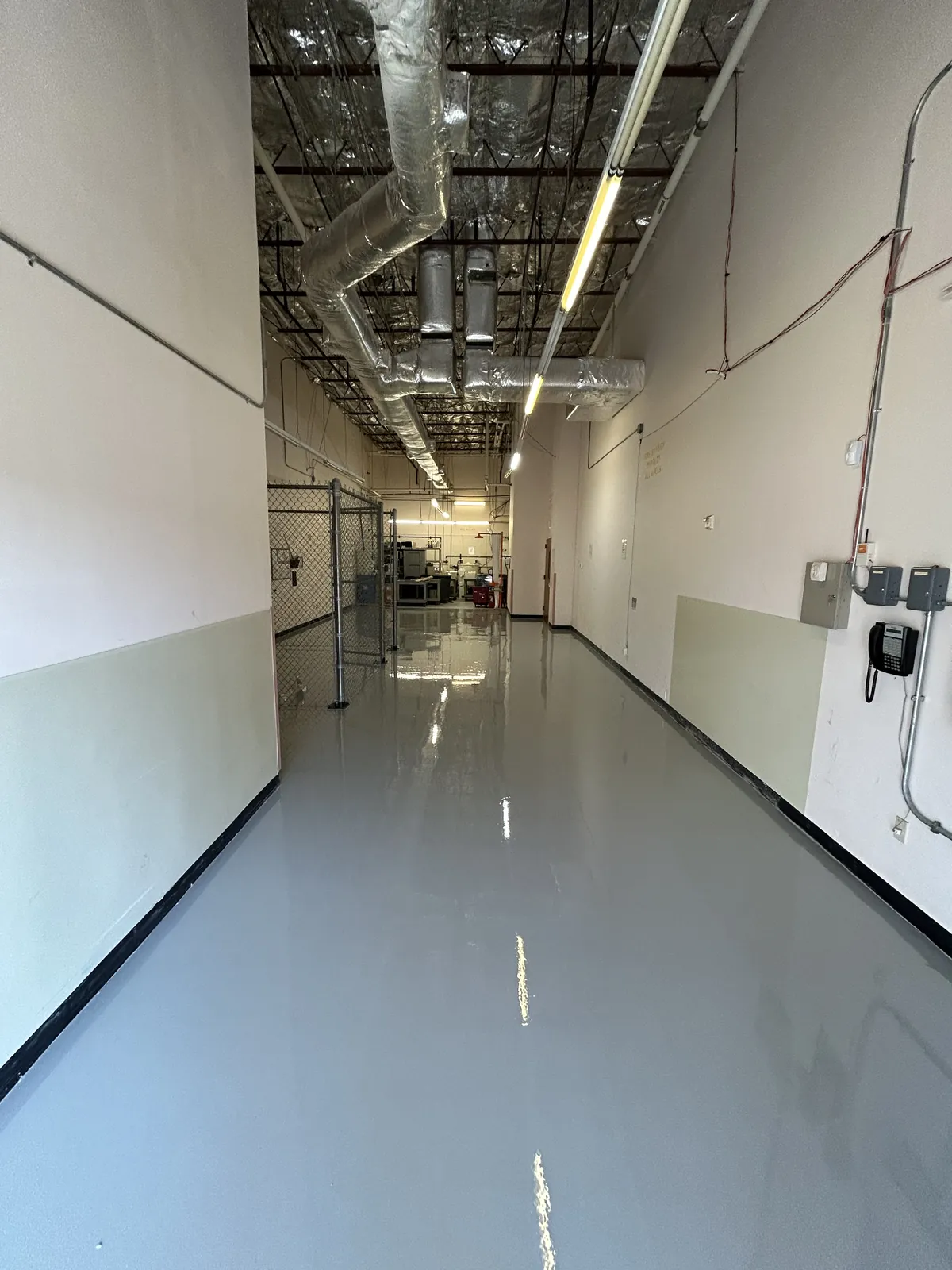
What forklift wheels do to a slab
Forklifts carry most of their weight on small, hard wheels, and they pivot in place at the end of every aisle. That twisting grinds at the same few spots all day. A thin coating rolled over a smooth slab gives up there first, peeling in patches that spread a little more every shift.
So industrial floors get built thicker, with a resin system picked for impact and abrasion. Prep matters even more here. Most of these slabs were power troweled smooth and hard when they were poured, and a coating holds poorly on that surface. We shot blast or grind until the concrete is open and rough enough for the primer to soak in. Shot blasting also shows us any weak, dusty top layer that would have pulled a coating off with it.
Saw-cut joints are the other weak point. We rebuild the spalled edges and fill the joints with a semi-rigid filler so the wheels roll across them instead of dropping in.
Forklift wheels slam the edges every time they cross, and an unprotected joint chips into a groove.
Matching the resin to what spills
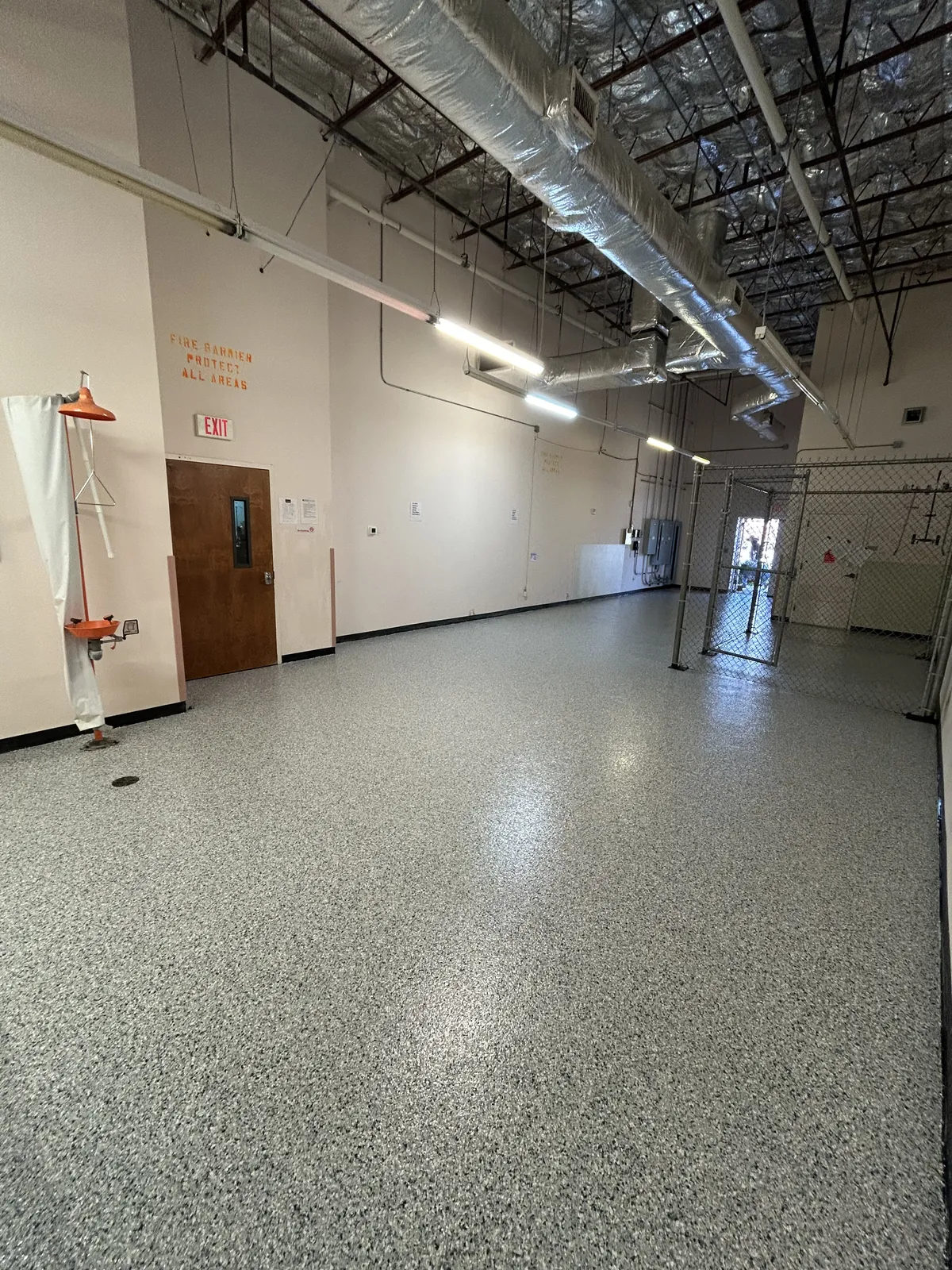
Every plant spills something different. Hydraulic fluid, motor oil, coolant, battery acid and cleaning solvents each attack coatings in their own way, and a floor that shrugs off one can soften or stain under another. Before we pick a system, we ask for the list of what gets used and dropped on that floor. Fuel and brake fluid belong on that list too if vehicles get serviced inside.
If the room sees strong acids, caustics or hot washdowns, a standard industrial epoxy may be the wrong floor, and we’ll point you to a chemical-resistant coating or polyurethane cement instead. A spill left sitting for days hurts any floor, so we also ask how quickly your people can get to one and clean it up.
Lines and zones people can read
A plant floor is also a set of instructions. Forklift aisles, pedestrian walkways, keep-clear zones around electrical panels and parking spots for equipment can all be striped into the coating and sealed under the topcoat, so the lines hold up far longer than floor tape. When a layout changes, new lines can go down over the old floor with a fresh topcoat on top.
Color is a practical call too. A light gray floor bounces shop light around and makes a dropped bolt or a fresh leak easy to spot. Darker floors hide tire marks better. We’ll talk through that tradeoff with whoever runs the floor day to day.
In five lines
- Looks like
- A thick, hard coat in a solid color, usually gray or another light shade, with aisles, walkways and hazard zones striped into it.
- Holds up in
- Warehouses, manufacturing floors, fabrication shops, mechanical rooms and loading areas with forklifts, pallet jacks and regular drips.
- Wrong pick when
- A sound slab that only sheds dust and sees dry traffic may be better off polished and densified, with no coating to wear through.
- Prep it needs
- Shot blasting or heavy diamond grinding to a rough profile, joint and spall repair, and moisture testing before any primer.
- Compared with
- It gets compared to polished concrete most often, and in harsh chemical rooms we look at chemical-resistant coatings or polyurethane cement.
Fits and misfits for industrial epoxy flooring
A good fit
- A warehouse with forklifts running the same aisles every shift.
- A manufacturing floor that sees oil, coolant and hydraulic drips.
- A dusty bare slab that needs a cleanable surface and striped aisles.
- A shop where heavy carts and pallet jacks roll all day.
Where we steer people elsewhere
- A dry storage floor that just sheds dust is often better as polished concrete.
- Rooms with hot water washdowns or heavy grease need polyurethane cement.
- Strong acid or caustic exposure calls for a chemical-resistant coating.
How an industrial floor gets built
Walk the plant
We walk the floor with whoever runs it and mark forklift routes, turning spots, drains and spill areas. We also get the chemical list and the hours the floor can be shut down.
Test and map
Moisture readings go across the slab, and we map every crack, spalled joint and patch of old coating. Big floors often have different conditions from one bay to the next.
Shot blast
Open areas get shot blasted to a rough profile, and the edges along walls and racks get diamond ground. Dust collection runs with both.
Fix joints and cracks
Spalled joint edges get rebuilt, cracks get filled, and control joints get a semi-rigid filler. This is the step that keeps a new floor from chipping along every saw cut.
Coat and stripe
Primer, then a thick body coat in the resin chosen for your wheels and chemicals. Lines and zones go down before the topcoat seals them in.
Return it in stages
Forklifts wait longer than foot traffic, and loaded racks wait longest. We give you a time for each so the floor isn’t put to work before it’s ready.
Part of Solid Color Systems
Industrial Epoxy Flooring is one of the services under solid color systems. The overview compares them all.
- Commercial Epoxy Flooring
For stores, offices, clinics and shops that can only close for a short stretch, so the system and the work schedule get planned as one decision.
- Industrial Floor Coatings
For production floors that get hit, scraped and hosed down every shift, where the coating thickness and the install schedule both come from how the plant runs.
- Protective Concrete Coatings
For bare slabs in shops, storage rooms and utility spaces that are wearing down or staining, where a sealer or thin coating adds a sacrificial surface.
- Polyurethane Floor Coatings
For the final clear coat on floors that get scraped by chair legs, carts and boots, protecting the epoxy beneath it and keeping a sheen longer.
Industrial Epoxy Flooring questions we answer a lot
Your question not here? (936) 445-0702 takes calls and texts, and the contact page has email.
How thick should a forklift floor be?
It depends on the wheels, the loads and how often they run. Carts and foot traffic can take a thinner system, while forklift aisles need a heavier build. We set the thickness after we see the floor and know what drives on it.
Can you coat over our old floor coating?
Only if it’s still bonded everywhere, which is rare on an old industrial floor. A new coating over a failing one fails with it. In most plants we shot blast the old coating off and start from clean concrete. That also lets us see what shape the slab is in.
Will the coating handle our chemicals?
Send us the list and we’ll match the resin to it. Some chemicals only harm a standard epoxy if they sit for hours, and some need a chemical-resistant system from the start. We’d rather sort that out before the job than after the first spill.
Can we keep running while you work?
Often, in phases. We can coat one bay or one side of the building while work goes on in the other, as long as forklifts and people stay off the fresh coating. The resin and the temperature decide how long each phase stays closed.
Do the expansion joints get coated over?
Control joints get a semi-rigid filler so wheels roll smoothly across them. True expansion joints, where the slab is meant to move, have to stay flexible, so we keep them open or use a flexible sealant. Coating straight over a moving joint just cracks along it.
Is an epoxy floor slippery with oil on it?
Any smooth floor gets slick with oil on it. We add grit to the topcoat in walkways and work areas where oil and coolant drip. More grit means more grip and a little more effort to clean, so we set it zone by zone.
Show us the floor and the spill list
Call or text (936) 445-0702 and tell us what drives on the floor and what lands on it. We’ll come out, test the slab and walk you through the system we’d build.
- Call or text(936) 445-0702
- Emailprocoatepoxyflooring@gmail.com
- Based inConroe, Texas, working six counties
Want to see the work first? Browse the gallery, or find every way to reach us.