
Brazoria County floors, from clay to coast
Brazoria County is the longest stretch of ground we cover, running from the south edge of Houston down to Freeport, where the Brazos River reaches the Gulf. Its floors run from subdivision garages on the north end to shop slabs on acreage and beach-house patios near the water, and the weather changes along the way. The farther south a slab sits, the more the air has to say about which system goes on it and how we prep it.
Humidity, salt and the slab underneath
Heat and humidity are part of every slab’s life in this part of Texas, and Brazoria County gets a heavier share of both near the coast. Salt rides in on the Gulf wind, settles on outdoor concrete and works into its pores with every rain. A coating that was never meant to live outside will chalk, yellow or lose its grip under that. On a patio, porch or pool deck down here we use a UV-stable system or a penetrating sealer, and we leave enough texture that wet feet stay planted.
Indoors, the wet air shows up as sweat. On a muggy day a garage slab that is cooler than the air can grow a thin film of water on its surface, the way a cold glass beads up. Prime a floor in that state and the water is sealed under the coating, where it can lift it later. We check the slab and the weather together on the day of the work, alongside the moisture reading from the visit, and if the concrete is sweating we wait it out.
Storms off the Gulf bring wind-driven rain and, on the lowest ground, standing water. A slab that has been under water can look dry on top within a day while the concrete below stays wet much longer. Any floor that has had water on it gets a new moisture reading, even if it tested well before, because the old number no longer describes that slab. If the reading comes back high, a moisture-mitigating primer goes down first.
Garages, shops and storefronts down the county
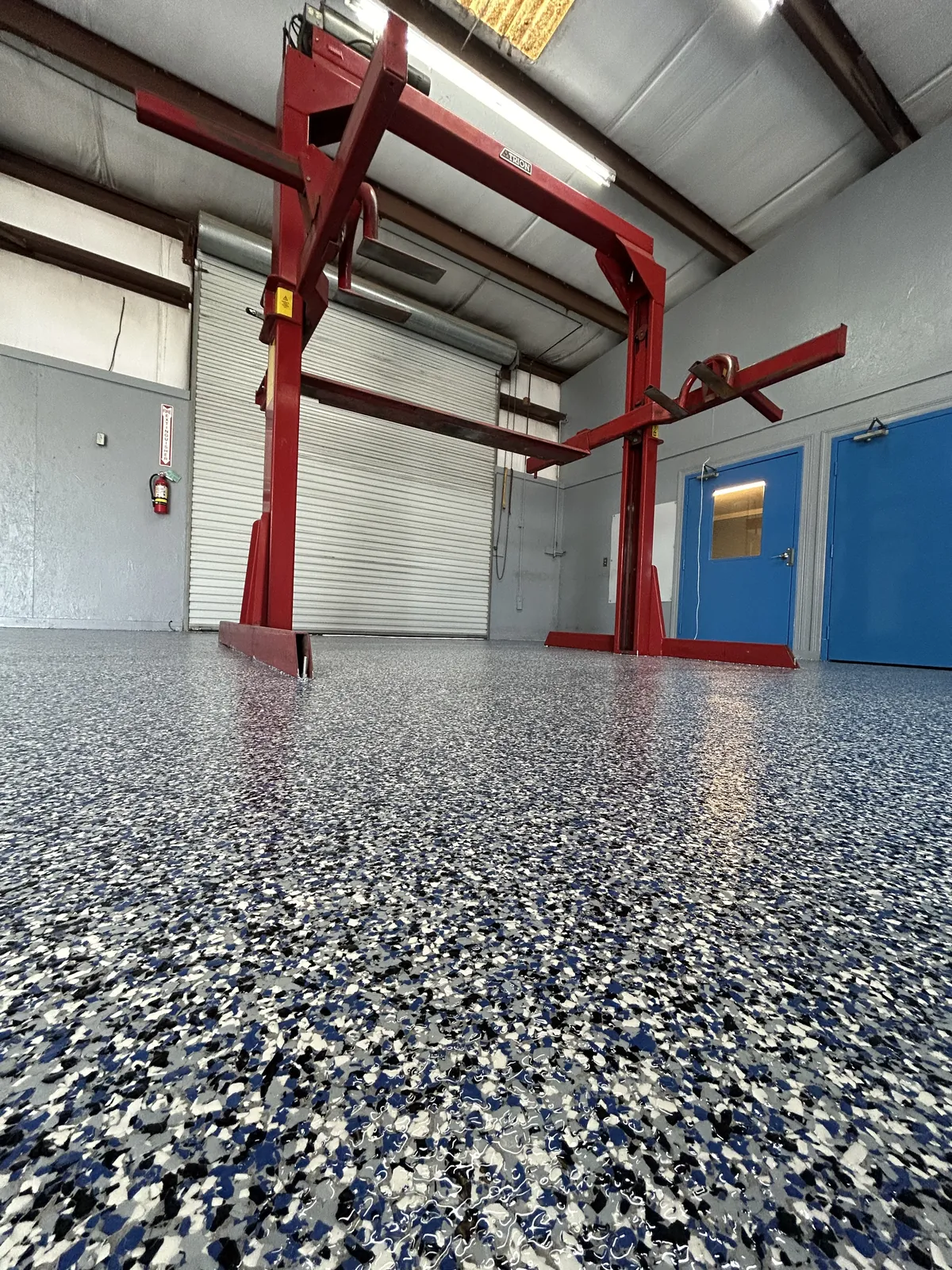
The north end of the county grew quickly, and many of its houses went up in large subdivisions built around the same time. Those garage slabs tend to share a story: troweled smooth by the builder, saw cut into panels, and sitting on clay that swells after rain and pulls back in a dry summer. Smooth builder concrete has to be ground open before primer will hold, and each crack gets judged on its own to see whether the clay is still moving it.
Farther out the lots get bigger and the floors work harder. Acreage around Alvin and the rest of the county carries pole barns, detached shops and carports where a tractor or a work truck lives, and those slabs collect fuel, hydraulic fluid and pasture mud. A slab that only stores equipment may need nothing more than hardening and a sealer. A shop where someone turns wrenches every weekend usually wants a coating that shrugs off spills and dropped tools.
Then there are the businesses: offices and clinics along the bigger roads, storefronts in the older town centers, restaurants, and service shops near the plants around Freeport. We walk those floors the way we walk a garage, then ask harder questions about what gets spilled, what rolls across it and how long the doors can stay closed. Sometimes the right answer is polished concrete or a plain sealer instead of a coating, and we say so at the visit.
Towns we cover in Brazoria County
Every town below has its own page about the slabs, buildings and floors we see there, and the same crew from Conroe comes to each of them.
- AlvinNorth Brazoria County
- AngletonCounty seat
- Lake JacksonBrazosport area
- FreeportGulf port
- CluteNorth of Freeport
- BrazoriaWest side, near the rivers
- West ColumbiaWest side, Brazos
- SweenyWest side, San Bernard
- RichwoodNext to Clute
- Iowa ColonyNew subdivisions
- DanburyMiddle of the county
- Oyster CreekEast of Freeport
- Surfside BeachOn the Gulf
- LiverpoolSmall town, mid-county
- Brookside VillageNorth edge of the county
What we put down in Brazoria County
The same six systems, and the same crew, everywhere we work.
- Flake Epoxy Systems
Colored vinyl flakes are broadcast into a wet base coat, then sealed under a clear topcoat. It hides dirt, small stains and tire marks, which is why most garage floors get it.
- Metallic Systems
Metallic pigment moves through the resin as it is worked, leaving a swirled, glassy floor with depth that shifts as you walk past. It belongs in showrooms, basements and living spaces where the floor is part of the look.
- Solid Color Systems
One even color with nothing to hide behind, built thick enough for carts and foot traffic. Warehouses and shops use it so aisles and safety zones can be striped and kept clean.
- Quartz Broadcast Systems
Colored quartz sand is locked into the resin in layers, leaving a fine grip underfoot. You see it in commercial kitchens, locker rooms and busy entries where floors stay wet.
- Polished Concrete
Bare concrete is ground with finer and finer diamonds until it shines on its own, then densified. There is no coating to peel, and it takes forklift traffic in warehouses and stores.
- Concrete Staining
Stain soaks into the concrete itself: acid stain gives mottled earth tones and water-based stain gives steadier color. It suits patios, porches and interior floors that want color without a thick coat.
Questions from Brazoria County
Not answered here? Ask us on the contact page or call or text (936) 445-0702.
How far south will you travel from Conroe?
All the way to the coast. Brazoria is the longest drive in our six counties, so we plan a visit here to cover every slab on the property in one trip. Call or text (936) 445-0702 with the address and what each floor is used for, and we will set a time.
What does salt air do to a patio coating?
Salt is harder on outdoor concrete than on a closed garage, because rain carries it into the surface and the sun works on whatever sits on top. Near the coast we use UV-stable coatings or a penetrating sealer on patios, porches and pool decks, with texture so they are not slick when wet. Rinsing off salt and grit now and then helps any outdoor finish last.
Why is my garage floor wet on muggy days?
That is usually condensation: warm, damp air meeting a slab that is cooler than it is. It is a different thing from moisture coming up through the concrete, and we check for both at the visit. A coated floor can still sweat in that weather, so a textured topcoat helps with footing.
Can a shop slab poured straight on dirt be coated?
Often, yes. Plenty of shop and barn slabs were poured without a vapor barrier, and those can push a lot of moisture, which puts real weight on the moisture reading. A high number means a moisture-mitigating primer under the system, and on some slabs a breathable sealer is the better choice.
We keep a boat in the garage. What floor handles that?
Boats come home dripping, and after a day on salt water that water leaves salt on the slab. A flake or polyaspartic system keeps it on the surface, where a hose takes it off, and the flake hides water spots between rinses. Trailer jacks press a lot of weight into one small spot, so we make sure the concrete under them is sound.
From our Google reviews
Matt Mayfield and his team did an excellent job of explaining the process to me and keeping me informed of how the progress was going. I have already recommended ProCoat to my neighbor and given him their business card.
Jewel, Google review
I have a long concrete porch that runs along my workshop. The old surface coating on it was an eyesore. The new flake epoxy flooring that Matt and his team applied looks awesome. It is obvious that they know their products and how to apply it properly.
Chris, Google review
A Brazoria slab, looked at in person
Call or text (936) 445-0702 with the address and a few words about what the floor goes through, or book a floor visit with the form. We will come down, test the slab and tell you plainly what it needs before any finish gets picked.
- Call or text(936) 445-0702
- Emailprocoatepoxyflooring@gmail.com
- Based inConroe, Texas, working six counties
Want to see the work first? Browse the gallery, or find every way to reach us.