
Lake Jackson slabs in the wet Gulf air
Outdoor slabs take the worst of it in Lake Jackson, near the Brazos River and close enough to the Gulf that the air is rarely dry. Salt, humidity and storm weather tend to reach floors here harder than anywhere else we work, so moisture is the first question we ask of every slab.
Concrete that rarely dries out
A slab on grade sits right on the ground, and near the coast that ground tends to stay damp. Water vapor moves up through concrete all the time, and more of it comes through when the soil underneath is wet and the air above is humid. You can’t see it from the top. A bare garage floor just looks a little darker in patches, or feels cool and tacky on a muggy morning. Clay soil holds that water close to the slab, and after a wet stretch it can take a long while to let go.
Trap that vapor under a film-forming coating and it pushes back. The first signs are usually small blisters, then patches that lift and peel, sometimes months after the floor looked perfect. That’s why we take moisture readings on every slab we look at here, garages, porches and pool decks alike, before anyone talks about color or flake.
The reading decides the primer. A slab in a normal range takes a standard primer. One that is pushing a lot of moisture gets a moisture-mitigating primer first, or in some cases a breathable penetrating product instead of a coating at all. Storms change the picture too. A slab that took water during a heavy rain needs time to dry back down before we test it, and we would rather come back another day than coat over a reading we don’t trust.
Plain epoxy is the wrong pick out there, because direct sun yellows it and breaks down the surface.
Pool decks near the coast
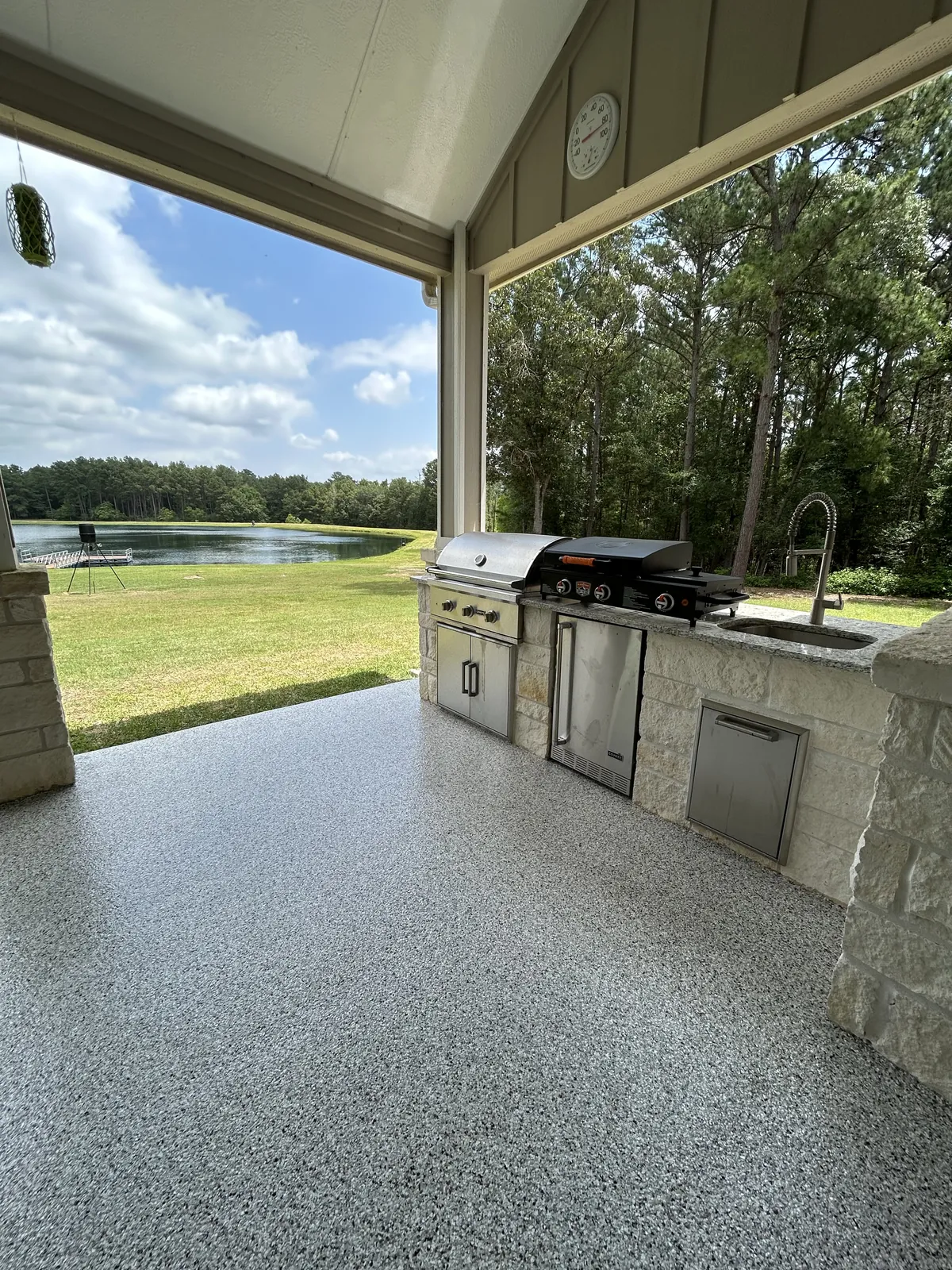
Pool decks here take sun, salt and standing water all at once. Salt from the air and from saltwater pools dries into the pores of the concrete, and as it crystallizes it can scale the surface away a little at a time. Add chlorinated splash-out and bare feet, and a deck needs a finish that stays grippy and does not get too hot to cross.
On a deck in good shape we usually use a UV-stable coating, often a polyaspartic, in a light color with grit in the topcoat. Where the deck is older and starting to scale, we grind back to sound concrete and repair the bad spots first, since a coating follows every pit underneath it. Some decks are better off with a penetrating sealer that lets the slab breathe, especially where water sits along the edges after every swim.
Upkeep counts for more this close to the Gulf. Rinsing the deck with fresh water now and then washes off salt before it builds up, and a topcoat that has started to dull is far easier to refresh than a deck that has worn through to bare concrete. Patio furniture with metal feet can leave rust rings in the salt air, so pads under the legs help.
Sand, salt and the garage hose
A garage near the coast collects things a garage inland does not. Beach sand comes in on tires and feet, salt rides in on the underside of the car after a drive along the water, and the floor gets hosed out more often because of it. Bare concrete takes some of that salt into its pores, and sand ground under tires slowly wears the surface down until it dusts. Salt water dripping off a car can also leave a white crust along the tire tracks if the floor never gets rinsed.
Where a garage only needs protection, a garage floor sealer keeps water and salt from getting into the slab and makes hosing out quicker. Where it needs a finish to look at too, a flake system with a UV-stable topcoat stands up to the sand far better than garage paint, and flake hides the fine sand that settles between sweeps, which a solid color shows right away. Either way, we grind and test the floor first, because a sealer over a weak, dusty surface comes off with the first good washdown. If the garage has taken storm water before, tell us, since that changes how long the slab needs before we test it.
Floors that suit Lake Jackson
Four we would put on the shortlist here, before we have seen your slab.
Matt Mayfield and his team did an excellent job of explaining the process to me and keeping me informed of how the progress was going. I have already recommended ProCoat to my neighbor and given him their business card.
Jewel, Google review
- Concrete Moisture Testing
Slabs on damp coastal ground can push a lot of vapor, and a reading taken before any coating or flooring goes down is the simplest way to head off blisters later.
- Pool Deck Coatings
Decks that take sun, salt from the air and splash from the pool need a light, UV-stable coat with grit so they stay cooler and grippy underfoot.
- Garage Floor Sealing
Garages that see beach sand on the tires and get hosed out often hold up better once a sealer keeps water and salt from soaking into the slab.
- Porch Coatings
Covered porches that stay damp on humid mornings need a coating with a primer matched to the moisture reading, plus grit for wet shoes coming in from the rain.
More towns in Brazoria County
The Brazoria County page lists every town we cover there.
Your Lake Jackson floor questions
Not answered here? Ask us on the contact page or call or text (936) 445-0702.
How dry does a slab need to be before you coat it?
There is no single number that fits every product. Each primer and coating is made to handle a certain amount of moisture, so we take readings and match the system to them. A floor that reads high gets a moisture-mitigating primer, or we wait for it to dry back down after a wet spell. Testing in more than one spot matters too, since a garage can read dry by the door and damp near the back wall.
Can a coated pool deck handle a saltwater pool?
It can, with the right product and some upkeep. Salt left to dry on any concrete surface can work into it over time, so a UV-stable topcoat and a fresh-water rinse now and then do a lot of good. We look at the deck’s condition first, since a deck that is already scaling needs repair before any coating. Grit in the topcoat keeps wet feet steady around the edge.
Our porch stays damp most mornings. Can it be coated?
Often, yes, but the dampness tells us something. Dew on a covered porch dries off by midday, while moisture coming up from below keeps coming back. We test to see which one it is. Dew means timing the work for a dry afternoon, and vapor from below may call for a breathable sealer or a moisture-mitigating primer.
What does a garage sealer do against beach sand?
A sealer won’t keep sand out of the garage, but it tightens the surface so grit doesn’t grind into open pores and the floor sheds less dust. It also keeps salt water from soaking in when the floor gets hosed out. For a garage that sees a lot of sand, a full flake system with a hard topcoat takes the wear better.
Can you test a slab before other flooring goes on it?
Yes. Moisture testing helps anyone putting wood, vinyl or tile over concrete, since those products have moisture limits of their own. We take the readings and tell you what we found. If a coating or polished concrete turns out to be the better choice for that room, we’ll explain why.
Line up a slab reading in Lake Jackson
Call or text (936) 445-0702 with the address and the floors you want looked at. We’ll make the drive down to Lake Jackson, test every slab and tell you which system each one can carry.
- Call or text(936) 445-0702
- Emailprocoatepoxyflooring@gmail.com
- Based inConroe, Texas, working six counties
Want to see the work first? Browse the gallery, or find every way to reach us.