
Sienna driveways, porches and the three-car garage
Curb appeal rides on the concrete in Sienna, the large planned community along the Brazos River in southeast Fort Bend County. Its streets are lined with driveways, front walks and porches that the neighbors see every day, and behind many front doors sits a garage wide enough to hold more than the cars.
Driveways the whole street can see
A driveway in a planned community gets looked at more than almost any other slab on the lot. Tire marks, oil drips where the second car parks, rust-colored spots from sprinkler water and the gray film that builds up in shade all show from the sidewalk. Most of it is grime sitting in open concrete, and a lot of it comes out with the right cleaner and a pressure wash before anything else goes on.
For most driveways we’d point you to a penetrating sealer instead of a coating. It soaks into the concrete and keeps water and oil from getting deep, while the surface keeps looking like concrete and keeps the grip it had. A film coating on a driveway can look sharp the first month, but it bakes in the sun all day and takes a turning wheel every morning, and a slick finish on a sloped drive is a poor trade when it rains.
Many planned communities have rules about what can change on the outside of a house, and a driveway color or a tinted finish can fall under them. Check with your association before asking for anything other than a clear sealer, and tell us what they need to see, so the product and finish can be named before anything goes down. A clear penetrating sealer changes the look very little, which is a big part of why it is the easy pick on a street where the driveways match.
Plain epoxy in that light will yellow, so it stays under a polyaspartic or another UV-stable top.
Front walks and the porch steps
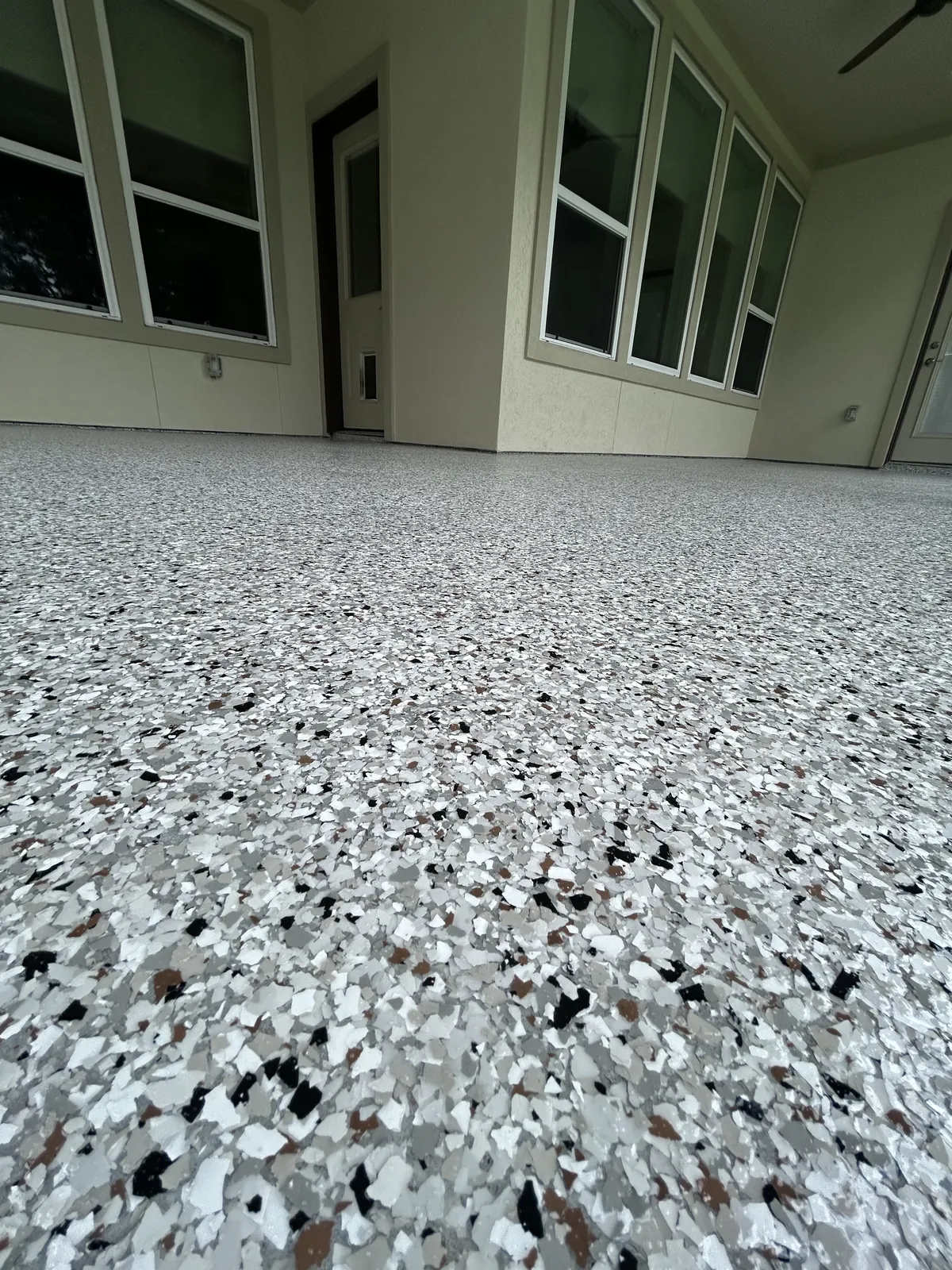
The front walk and porch take the footsteps of every guest and delivery driver, often in a summer downpour. Those slabs tend to hold water, too: a porch with little slope keeps a thin sheet of rain on it after the clouds pass, and smooth steps get slick once that water mixes with pollen or a little algae in the shade. On a north-facing porch that never gets direct sun, the surface can stay damp well into the next day.
On a covered porch we often suggest a coating with grit broadcast into the topcoat, so wet shoes have something to grab. Flake hides the dust that blows in, and a UV-stable topcoat matters even under a roof, because low morning and evening sun reaches farther onto a porch than people expect.
Steps need more care than the flat part of the porch. Edges chip, water sits in the corner where the tread meets the riser, and a crack at the bottom step is common where the porch and the walk move separately on the clay. We repair the edges and fill the cracks before coating, and where two slabs meet we leave a joint so the movement has somewhere to go instead of tearing the new finish.
One wide garage, three different jobs
A three-car garage rarely holds three cars. One bay usually fills with bikes, a stroller, a workbench or a second freezer, while the other two take the daily drivers. Riding mowers and kids’ bikes turn in tight circles in that third bay, which scuffs a topcoat in arcs. Each part of the floor wears in its own way: hot tires and oil drips in the parking bays, dragged shelving and dropped tools in the third. The system we pick has to handle both.
We usually run one system across the whole floor so it reads as a single room, most often a full flake broadcast over a ground and primed slab, sealed with a clear topcoat. A wide garage also has more control joints and a longer threshold where rain blows in, so we take moisture readings in more than one spot, fill the cracks and keep the joints as clean lines. Plan on the fullest bay being emptied too, because the coating has to reach the wall.
Floors that suit Sienna
Four we would put on the shortlist here, before we have seen your slab.
Matt Mayfield and his team did an excellent job of explaining the process to me and keeping me informed of how the progress was going. I have already recommended ProCoat to my neighbor and given him their business card.
Jewel, Google review
- Driveway Sealing
A street-facing driveway usually looks best with a clear penetrating sealer that keeps oil and water out and leaves the concrete’s grip alone.
- Porch Coatings
A front porch that holds rain after a storm needs grit in the topcoat and a top layer that keeps its color in the low sun.
- Garage Floor Flake Systems
A full flake broadcast across all three bays hides tire dust and tool scuffs, and it makes a wide garage read as one room.
- Walkway Sealing
Front walks that turn slick in the shade do better with a sealer that keeps water out of the surface than with a glossy film on top.
More towns in Fort Bend County
The Fort Bend County page lists every town we cover there.
- Meadows PlaceOff US 59
- FresnoFM 521, new subdivisions
- Pecan GroveNear Richmond, Brazos
- Mission BendWest Houston suburb
Floors in Sienna, asked plainly
Something else on your mind? Call or text (936) 445-0702, or use the contact page.
Do I need my association’s approval to seal a driveway?
That depends on your association’s rules, so ask them first. A clear penetrating sealer usually changes how a driveway looks very little, while a tinted sealer or a coating changes it a lot more. Ask at the assessment which product and finish we would use, so you have something specific to send in. If the association wants to see the look first, bring that up at the assessment and we will talk through how to show it.
Will sealing my driveway make it slippery?
A penetrating sealer soaks into the concrete instead of forming a film on top, so the surface stays close to the grip it had. Film-forming sealers and coatings are the ones that can turn slick in the rain, which is why we steer driveways away from them, and on a steep drive we’d hold to that.
Can you coat the porch steps without the edges chipping?
Edges chip when the concrete under them is already loose or when a coating stops in a thin, sharp line. We grind the edges, repair any broken nosing and carry the coating over the edge instead of ending it flat at the lip. A step that gets kicked every day will still wear first, and a fresh topcoat there later is a small job.
Do all three bays have to be emptied at once?
For one continuous floor, yes, because the grinding, the base coat and the topcoat each go across the whole slab in one pass. Doing it bay by bay leaves seams where the coats overlap. Most people park on the driveway for the job and stack the third bay’s contents in the yard or a rented storage unit.
Why test for moisture in a garage that has never taken on water?
Water vapor moves up through a slab from the ground even when the floor looks dry, and concrete near a river can sit on soil that stays damp for long stretches. A coating traps that vapor, and it can push the coating up in blisters months later. A reading in a few spots tells us whether a standard primer will hold or the floor needs a moisture-mitigating one.
Walk the front of the house with us
Call or text (936) 445-0702 and tell us which slab is bothering you: the driveway, the porch or the garage. We’ll come out, test it and tell you what we’d put down and what it needs first.
- Call or text(936) 445-0702
- Emailprocoatepoxyflooring@gmail.com
- Based inConroe, Texas, working six counties
Want to see the work first? Browse the gallery, or find every way to reach us.