
Pinehurst floors for barndominiums and metal buildings
Shop and pole barn slabs turn up all over Pinehurst, in the SH 249 and FM 2920 country near Magnolia. When the slab of one of those buildings is also the floor of the house, the finish has to suit bare feet and a workbench under the same roof.
One slab under the kitchen and the shop
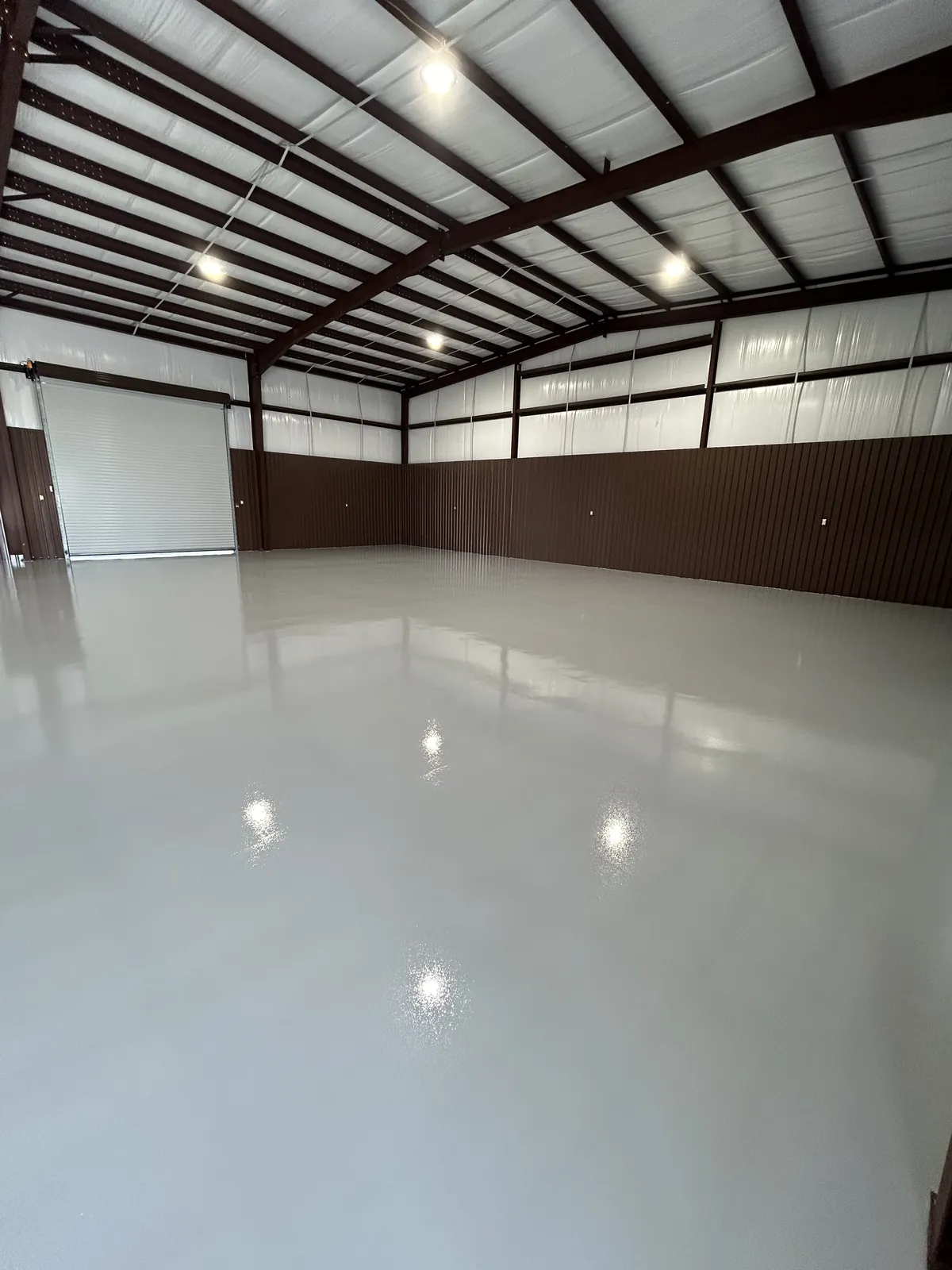
A barndominium puts the house and the work space on the same pour, or on two pours that meet at a wall. The living side gets bare feet, dining chairs, a dog’s water bowl and the occasional dropped pan. The shop side gets a tractor, a mower deck, a welder and whatever leaks out of them. One finish rarely does both jobs well, so it usually makes sense to plan the two halves as two floors that happen to share a slab.
On the living side, the concrete itself often becomes the floor. Ground and polished to a satin or matte sheen, it sweeps easily, carries no coating that can peel and keeps glare down under big windows. A densifier soaks in and hardens the surface along the way, which cuts the dust a bare slab gives off. If the slab was poured rough or patched, a stain or a thin overlay can even out the look before it is sealed.
The shop side wants a coating instead, such as a thick epoxy or a flake system under a chemical-resistant topcoat, so oil and hydraulic fluid stay on top long enough to wipe up. Where the two floors meet, the line needs a plan. A clean saw cut, an existing control joint or the base of a wall all make a tidy edge, and it is worth deciding where that edge goes before any grinding starts. Grinding dust and fresh coating also have to be kept apart, so the two sides are usually done in an order that keeps work on one half from fouling a new coat on the other.
Grinding takes most surface marks off, since it cuts away the top skin of the slab.
Rust marks and drywall mud on the slab
A living floor in a metal building often starts as a slab that sat out in the weather while the frame went up, then got walked on through the whole build. By move-in day it can carry rust marks from steel, drywall mud, paint overspray, tape residue and tire tracks from a lift. Every one of those is a problem for a polished or stained floor, because both finishes show the concrete as it is and cover nothing.
Rust can run deeper than a light polish reaches, and that changes the plan. Either the floor gets ground deeper, with more of the stone in the concrete showing, or it moves to a stain or a coating that can hide the mark. A small test area answers that question before the whole floor is committed.
Moisture matters here too. A slab that was rained on through the build, or one poured without a vapor barrier under it, can keep pushing vapor up for a long time. We test for it before choosing anything. Bare polished concrete usually copes with some vapor, while a coating over a damp slab may need a moisture-mitigating primer to stay put.
Where the lean-to roof stops
A shop or barn with a lean-to or an open bay on one side ends up with a slab that is half under the roof and half out in the weather. The strip at the drip line takes the worst of it: rain off the roof edge, mud from boots and tires, and full afternoon sun. Plain epoxy yellows and chalks out there, and a slick finish turns into a hazard after a summer storm. Leaves and pine straw pile up against the open side too, and they hold water on the concrete long after the rain stops.
Under the covered part, a UV-stable coating such as polyaspartic holds its color where the sun reaches in, and grit in the topcoat gives boots something to grip. Out past the drip line, a penetrating sealer is often the better choice. It soaks in, keeps water and stains out and leaves the concrete as grippy as it was. The clay under an open pad moves with the weather, so we look at every crack before either one goes down.
Floors that suit Pinehurst
Four we would put on the shortlist here, before we have seen your slab.
Matt and his guys did an amazing job today and yesterday. Communication was great, service was awesome, and finished product looks amazing!
Austin Colson, Google review
- Satin Concrete Finishes
A barndominium living floor ground to a satin sheen is easy to sweep, has nothing on top to peel and stays calm under big windows.
- Concrete Densifier Application
A densifier hardens a polished living slab from the inside and cuts the dust bare concrete gives off, which matters when it is the floor of the house.
- Workshop Floor Coatings
The shop half of a metal building takes tractors, welders and dripping mower decks, so it needs a coating made for work.
- Penetrating Concrete Sealers
An open pad past the lean-to drip line takes sun and blown rain, and a penetrating sealer protects it without making the surface slick.
More towns in Montgomery County
The Montgomery County page lists every town we cover there.
- Roman ForestEast side, pine woods
- Cut and ShootJust east of Conroe
- StagecoachSouthwest county
- New CaneyUS 59, near Porter
Asking about floors in Pinehurst
Something else on your mind? Call or text (936) 445-0702, or use the contact page.
Can one barndominium slab be polished on one side and coated on the other?
Yes. The living side can be ground and polished while the shop side gets a coating, with the two finishes meeting along a saw cut, a control joint or a wall. Settling where that line falls early keeps the edge clean. We test moisture on both sides, since each half may have been poured or exposed differently.
Will polishing take out rust stains left by the steel frame?
Light surface marks usually grind out. Rust that has soaked deeper can survive a light polish, so a small test area is the honest way to find out. If it will not come out, a stain, an overlay or a coating can cover it instead.
Is a polished concrete living floor hard on the feet?
It is as hard as any concrete floor, so a rug helps where you stand for long stretches, such as at the kitchen counter. Through a Texas summer the cool surface is often welcome. A satin or matte sheen also feels softer to the eye than high gloss and hides scuffs better.
Should the open pad beside my shop be coated or sealed?
Usually sealed. A pad out in the weather takes full sun, standing water and clay movement, which is hard on any coating. A penetrating sealer soaks in and keeps water and stains out without making it slick. If you want color under the covered part, a UV-stable coating with grit in the topcoat is the better pick there.
Do you test moisture before polishing a living floor?
Yes, before every system. Polished concrete copes with some vapor better than a coating does, but a very damp slab can still cause trouble for stains, sealers and anything laid on top, like rugs with rubber backing. The reading tells us which products suit the slab.
Walk the whole building with us
Call or text (936) 445-0702 and tell us how the building is split between living space and shop. We’ll test both sides of the slab and tell you which finish belongs on each.
- Call or text(936) 445-0702
- Emailprocoatepoxyflooring@gmail.com
- Based inConroe, Texas, working six counties
Want to see the work first? Browse the gallery, or find every way to reach us.